● Tips are now live — tips@peoplevsbiloxi.com
On Tuesday, March 3, 2026, the Biloxi City Council voted to approve a raise for Jerry Creel.
The motion was introduced by the Biden of Biloxi himself—Mayor "FoFo" Gilich—and the Burger King, Council President Kenny Glavan. Before the vote, the undersigned addressed the Council directly and made a promise: if you approve this raise, you will have to deal with us.
The Council's response was to have Jarrod removed by police.
Then they voted yes.
So here we are. Let's start with Kenny.
To every councilmember who raised their hand in favor: welcome to the jungle. The undersigned may not talk about you today—but know that I am there in spirit with you. And soon enough, we shall rejoice together.
That's not a threat—it's a promise, in its most pure form. Be patient.
But today, we will talk about one of the alpha daddies of Biloxi—Jerry Creel. Dude's a legend. He's the guy with all the hats. He gets the girls. He's so rad they'll have to remake the word legendary to legenJERRY. He's got the HR Manager of the City of Biloxi as a Saturday snack—on city property. And now he's got a Police Interceptor in the driveway to prove it.
And you can't make legenJERRYS pay for simpleton things like car, taxes, and fuel.
A Word for the Burger King

Kenny Glavan—Ward 6 Councilman, Council President, and, most relevantly, Area Director of Hotel Operations at Lodging & Leisure LLC and President of the Mississippi Hotel and Lodging Association.
Our studies on Kenny Glavan are just beginning, but what we've found so far is very interesting.
First, it's obvious—he's a friend of the cartel. He's with the Biden of Biloxi. He pushes their agenda, defends their allies, and is in pure synchrony with the machine. Apparently, Kenny is being set up to assume FoFo's position in the next election. You wish, boy Kenny.
You see, Kenny sits on the Biloxi City Council and votes on ordinances that regulate short-term rentals—the same short-term rentals that compete directly with the hotels he operates and the hotel association he presides over. When Airbnb filed a federal lawsuit against the City of Biloxi in 2025, the complaint alleged that the City conspired with the Mississippi Hotel and Lodging Association to restrict short-term rentals and boost hotel profits. Kenny Glavan was named. The complaint alleges he was the deciding vote that killed a Planning Commission proposal to create a district where short-term rentals would be permitted—and that he voted instead of recusing himself despite his massive conflict of interest.
A hotel executive who votes to restrict the competition of hotels. And calls the conflict of interest accusations "troubling." The only thing troubling, Kenny, is that you thought nobody would notice.
And Kenny—now that you're also being sued, a friendly reminder: no more executive sessions with my name on it. Everything from here on out is on the record. In public. Where the people of Biloxi can see exactly who you are and exactly what you do.
As for the mayoral aspirations? Forget them. By the time the undersigned is finished, the only thing you'll be running is a damage control operation.
But that's a story for another day. Today we talk about the city car.
My dear litigation war diary,
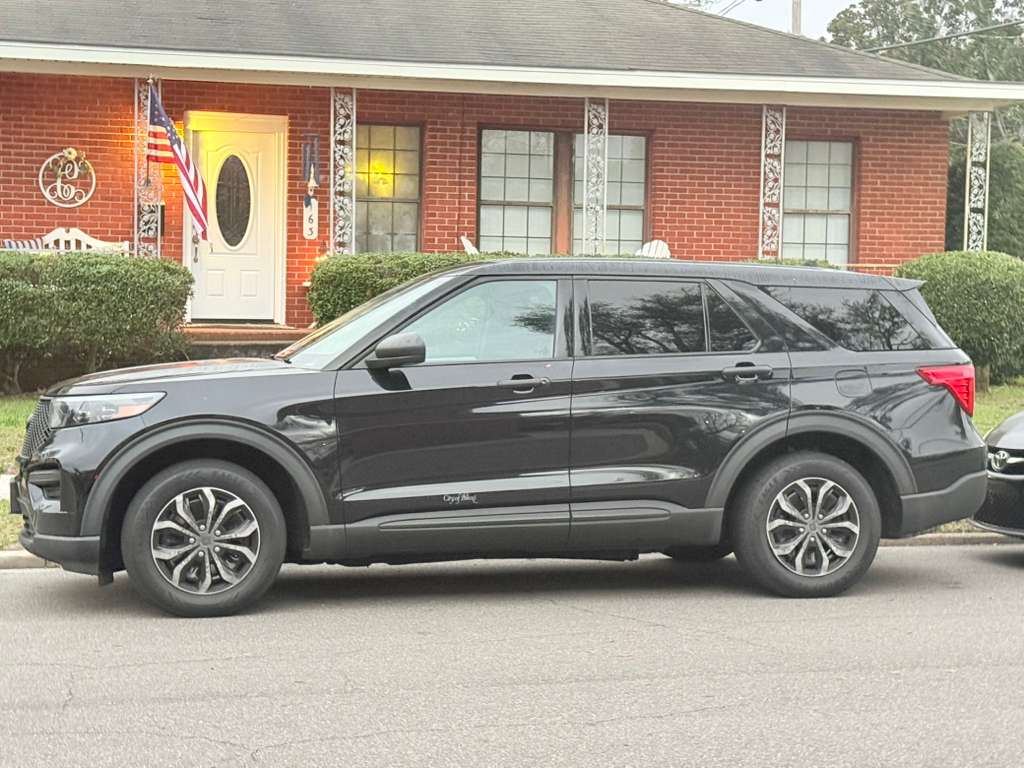
The undersigned has made a curious observation. Every evening, as the good citizens of Biloxi sit in traffic on their way home from work—in vehicles they purchased with their own money, insured with their own premiums, and fueled with their own wages—a particular automobile glides past. You'd never know it was a city vehicle. There's no big decal. No "CITY OF BILOXI" in bold letters on the doors. Just a tiny cursive script—black on black, maybe an inch tall—that disappears against the paint like it was designed to.
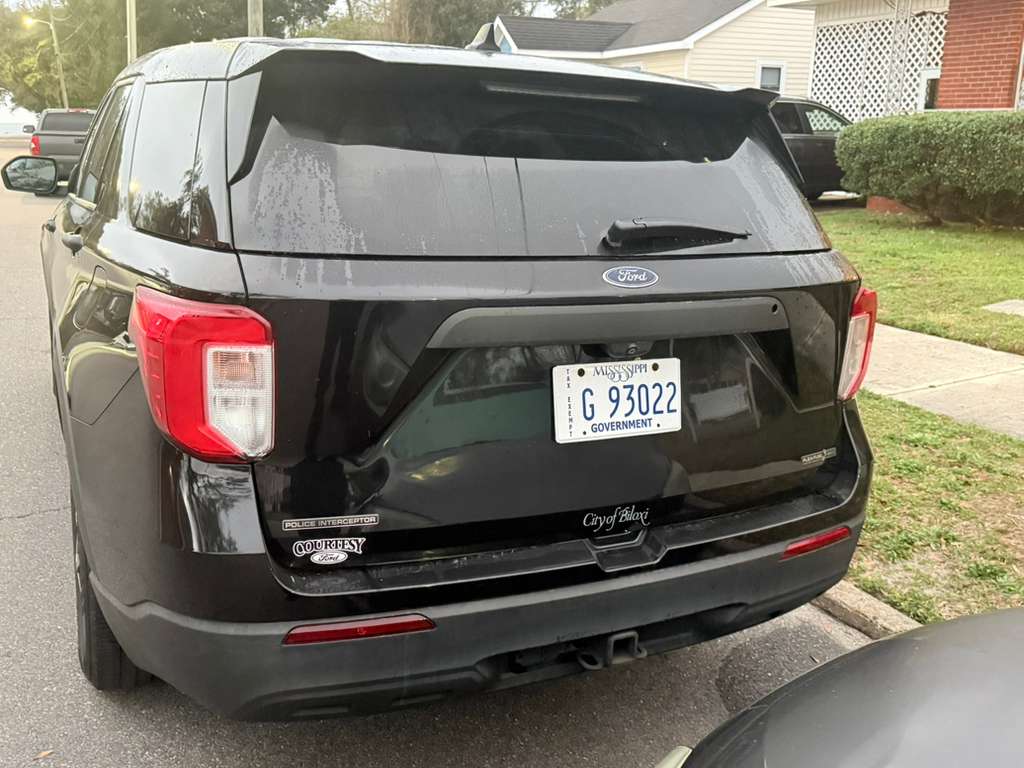
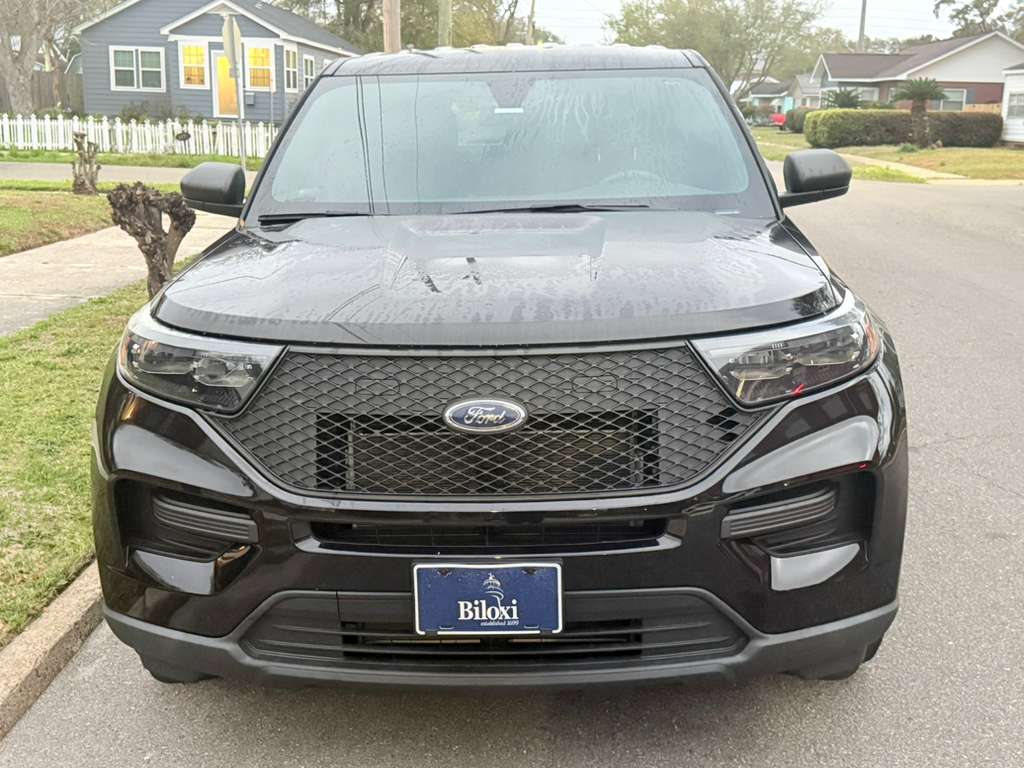
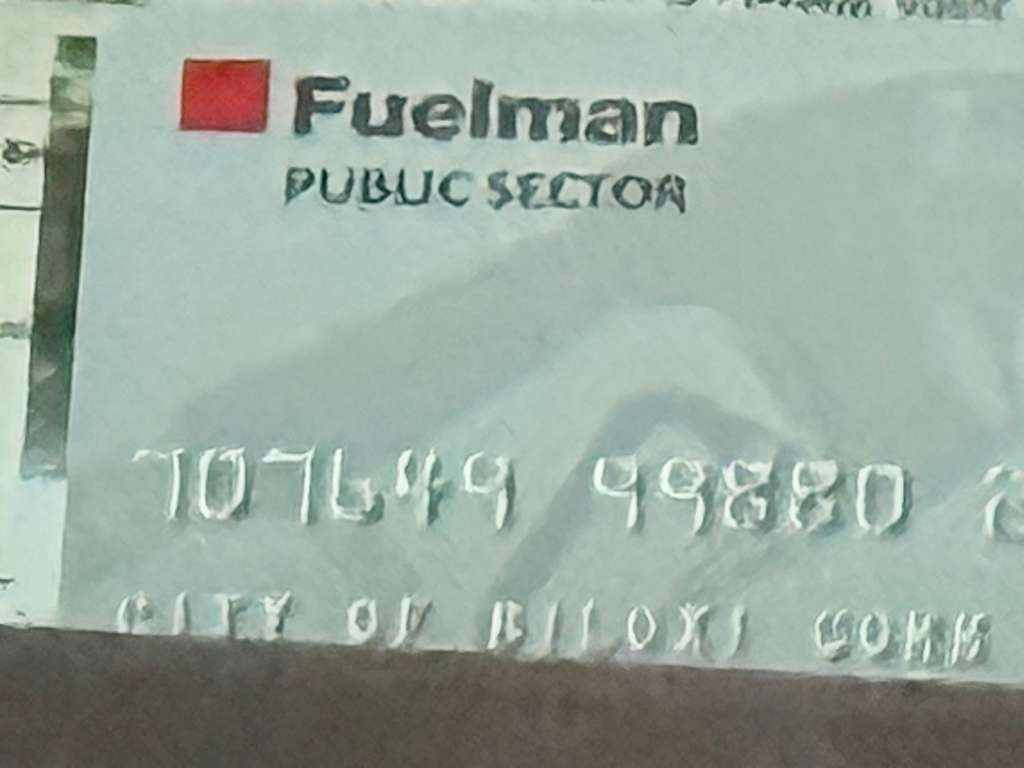
It's a Ford Explorer Police Interceptor—a law enforcement vehicle model—wearing Mississippi government plate G 93022. It's fueled by a Fuelman PUBLIC SECTOR card stamped "CITY OF BILOXI COMM"—that's Community Development. Your tax dollars at the pump.
Behind the wheel sits Jerry Creel—Director of Community Development, Building Official, Code Enforcement Director, Secretary to the Board of Adjustments and Appeals, and Historic Preservation Director. Five titles. One head. And now, apparently, one taxpayer-funded Police Interceptor to take home every night—to 163 Peter Street, a house owned by the estate of A.J. Holloway, Biloxi's longest-serving mayor (1993–2015). The Building Official lives in the former mayor's house and drives a Police Interceptor home on the taxpayer's dime. You can't make this up.
The undersigned, being a curious sort—and having some experience with Mr. Creel's creative interpretation of the law—decided to look into what Mississippi actually says about municipal employees treating city vehicles like personal property.
Dear reader, what we found will make your blood boil.
I. The Law Is Crystal Clear
Mississippi does not leave this question open to interpretation. The legislature, the Attorney General, the Ethics Commission, the IRS, and the State Auditor have all spoken with one voice: personal use of a government vehicle by a municipal employee is illegal.
Not frowned upon. Not discouraged. Not a gray area. Not a perk. Illegal.
Read that again. Any officer. Any employee. Any person whatsoever. Not "some employees." Not "employees who aren't directors." Not "employees who don't have five job titles." Any person.
And "any purpose other than official business" means exactly what it says. Driving to the grocery store? Illegal. Picking up the kids from soccer? Illegal. Commuting from your house to City Hall every morning in a vehicle that taxpayers bought, taxpayers insure, and taxpayers fuel? Illegal—unless the City Council has formally authorized it on the record, for a documented public purpose.
The Mississippi Attorney General has made this even more explicit. In Opinion No. 2020-00065 (May 13, 2020), the AG stated plainly:
"Allowing municipal employees to use municipally owned vehicles for personal use would result in unlawful donations of municipal funds."
Under Mississippi Code § 21-17-5(g), municipalities are prohibited from granting "donations" of public property. When a city employee drives a city car home for personal convenience, the city is donating fuel, insurance, depreciation, and wear-and-tear to a private individual. That's not a perk. That's not a benefit. Under Mississippi law, it's an unlawful donation of public funds—a violation of both the statute and Article 4, Section 66 of the Mississippi Constitution.
This isn't a technicality. This is the foundational principle of Mississippi municipal law: public money cannot be used for private benefit. (FoFo may have a heart attack if you read this to him and he's not prepared for it.)
II. The Three-Inch Rule
Even if Jerry Creel had some legitimate reason to use a city vehicle—and we'll get to why he doesn't—Mississippi law imposes strict requirements on how that vehicle must be identified.
BOTH SIDES
REAR
IMPOUNDED
Note the phrase: "political subdivision thereof." That's legalese for cities and counties. The City of Biloxi is a political subdivision of Mississippi. Every vehicle it owns or leases—every single one supported by tax dollars—must have "CITY OF BILOXI" painted or decaled on both sides in letters at least three inches tall, in a color that contrasts with the vehicle's paint.
The law is specific. Not a small logo. Not a discreet sticker you'd need a magnifying glass to read. Not a non-reflective decal the size of a business card. Three-inch letters. Both sides. Contrasting color. Permanent.
What's Actually on the Car
Look at the photographs above. Jerry Creel's city vehicle—a black Ford Explorer Police Interceptor, government plate G 93022—does not have three-inch letters on both sides. It doesn't have one-and-a-half-inch contrasting letters on the rear. What it has is a tiny cursive script that reads "City of Biloxi" in what appears to be black lettering on a black vehicle.
Black on black. Cursive. Maybe an inch tall. No contrast whatsoever.
The law says: three inches, contrasting color, both sides. What's on this vehicle fails every single requirement. The letters aren't three inches—they're barely one. The color doesn't contrast—it's black on black, invisible unless you're standing two feet away squinting. And the side view speaks for itself: you could drive past this vehicle a hundred times and never know it belonged to the City of Biloxi.
Meanwhile, look at the rear. There's a "POLICE INTERCEPTOR" badge on the left side of the tailgate—a badge identifying this as a law enforcement vehicle model. But Jerry Creel is not law enforcement. He's a Building Official. He inspects houses and files code violations. Why does the Director of Community Development need a Police Interceptor?
And then there's the Fuelman card. A government fuel card—Fuelman PUBLIC SECTOR—stamped with "CITY OF BILOXI COMM" at the bottom. That's Community Development. Every gallon of gas that goes into this Police Interceptor while it sits in Jerry Creel's driveway comes out of your pocket, Biloxi.
That's not an oversight. That's not a clerical error. That's not the fleet manager running out of big decals. That's a deliberate choice. Black cursive on a black car. A Police Interceptor with no police inside. A Fuelman card burning through taxpayer money.
Why would a public official want his government vehicle to look like a personal car? There's only one reason: so that when he drives it home to 163 Peter Street—to the house owned by the estate of former Mayor A.J. Holloway—parks it in the driveway, runs errands, and uses it for personal business, nobody knows it's a city vehicle. Nobody asks questions. Nobody reports it. Nobody calls the State Auditor.
The tiny black-on-black script is the tell. It's the confession. It says: I know this is a government car. I know it's supposed to be marked. And I've chosen to make that marking as invisible as possible—because I'm using this car for things I shouldn't be using it for, and I don't want you to know.
And if a city vehicle doesn't comply? The enforcement mechanism has teeth:
Five days. That's it. The State Auditor doesn't send a polite letter. Doesn't schedule a meeting. Doesn't form a committee. Five days to comply, or the vehicle is impounded.
The Unmarked Vehicle Exception
The law does allow certain vehicles to be unmarked. But the exceptions are narrow, specific, and every single one involves law enforcement:
- Police vehicles used in criminal investigations where markings would hinder the investigation
- Department of Human Services Fraud Investigative Unit vehicles
- State Fire Marshal vehicles (up to three)
- Airport security vehicles when markings would compromise airport security
- Bureau of Narcotics and Department of Public Safety vehicles
Notice anything? Every single exception involves law enforcement, criminal investigation, or security operations. There is no exception for Building Officials. No exception for Community Development Directors. No exception for Code Enforcement. No exception for anyone whose job is to inspect buildings, issue permits, or file criminal charges against citizens who paint their porch the wrong color.
We already know Jerry Creel's city vehicle is NOT marked with three-inch contrasting letters on both sides. It has a tiny, non-reflective sticker that doesn't come close to compliance.
So the questions become: Who authorized this violation? Did the City Council approve an unmarked vehicle exemption, entered on the minutes, with a certified copy sent to the State Department of Audit?
Because if they didn't—and there's no exception for Building Officials in the statute—then under § 25-1-87, the State Auditor has the authority to impound that vehicle in five days.
III. He's Not a Cop
This is the part that matters most, and the part the City of Biloxi would prefer you didn't think about too carefully.
Mississippi law does recognize a narrow exception for certain employees to take government vehicles home. The Attorney General has acknowledged that a municipal governing board may authorize home-to-work commuting in a city vehicle—but only if:
- The governing board makes a formal determination, spread on the official minutes
- The determination states that the commute is "necessary" for the employee to perform their duties
- The arrangement serves the "best interest of the city"
- The employee serves a 24/7 on-call emergency response function
Think police chiefs. Think public works directors who might need to respond to a water main break at 2 AM. Think fire marshals. People whose job requires them to be available around the clock for genuine emergencies that threaten public safety.
Now think about Jerry Creel.
What emergency does a Building Official respond to at 2 AM? A rogue fence post? A pergola erected without a permit under cover of darkness? A historic district violation that simply cannot wait until morning?
Building inspections happen during business hours. Code enforcement happens during business hours. Permit reviews happen during business hours. There is no building emergency that requires a Community Development Director to have a taxpayer-funded vehicle sitting in his driveway at midnight.
And unlike police officers—who have a specific statutory authorization under Mississippi Code § 21-19-49 and related provisions to use official vehicles for off-duty volunteer services and private security, with formal governing authority approval—there is no corresponding statute for building officials. None. The legislature considered which municipal employees might legitimately need take-home vehicles, and building officials didn't make the list.
The Biloxi Police Department has a formal Assigned Vehicle Program. Officers pay a monthly fee ($20–$100) based on their distance from city limits. The program has rules. It has oversight. It has a public safety justification.
Does Jerry Creel pay a monthly fee? Is there a formal program for the Community Development Director? Was it approved by resolution spread on the minutes? Is there a documented public safety justification?
We'd love to see the paperwork.
IV. The IRS Wants to Know Too
Even if—hypothetically—the City of Biloxi properly authorized Jerry Creel to commute in a city vehicle, there's another problem. The IRS treats personal use of an employer-provided vehicle as a taxable fringe benefit.
Under 26 U.S.C. § 61 and IRS Publication 15-B, the value of an employee's personal use of a company vehicle must be reported on the employee's W-2 as taxable income. The city must calculate this value. The employee must pay income tax on it. This is not optional.
The IRS does exempt certain vehicles from this requirement—but only "qualified nonpersonal-use vehicles." These include:
- Clearly marked police, fire, and public safety vehicles
- Ambulances and hearses
- Specialized utility trucks with permanently mounted equipment
- Vehicles that, by their nature, are not likely to be used for personal purposes
A regular sedan or SUV driven by a Building Official? Not qualified. Not even close.
And here's the kicker: because Creel is a department director—a "control employee" in IRS terminology—he can't even use the cheap $3.00/day commuting rule. He'd need the full Annual Lease Value method, which could add thousands of dollars to his taxable income.
Is the City of Biloxi reporting Jerry Creel's vehicle commute as taxable income on his W-2? If not, both the city and Creel have an IRS problem.
In April 2025, State Auditor Shad White's office issued a comprehensive report highlighting systemic failures by Mississippi municipalities to accurately track the personal use of city vehicles—resulting in massive IRS violations regarding unreported taxable income. In June 2025, a Panola County Road Department employee pleaded guilty to embezzlement for using a county fuel card to gas his personal vehicle. He got 10 years of post-release supervision and nearly $10,000 in restitution.
That was for a fuel card. A Fuelman card—just like the Fuelman PUBLIC SECTOR card stamped "CITY OF BILOXI COMM" that fuels Jerry Creel's Police Interceptor. Except Creel isn't just using a gas card. He's got the entire vehicle—driven home every day, fueled by the city, insured by the city, maintained by the city. What's the value of that?
V. The Ethics Violation
Mississippi's Ethics in Government Law—§ 25-4-105(1)—prohibits any public servant from using their official position to obtain a "pecuniary benefit" for themselves.
A pecuniary benefit is a financial advantage. Money saved. Value received. Compensation beyond what your position provides.
A free car is a pecuniary benefit. The fuel to run it is a pecuniary benefit. The insurance that covers it is a pecuniary benefit. The maintenance that keeps it running is a pecuniary benefit. Every mile Jerry Creel drives that city vehicle for personal purposes represents a financial benefit extracted from taxpayers through his official position.
The Mississippi Ethics Commission can impose:
- Censure—public reprimand
- Fines up to $10,000
- Recommendation to the Circuit Court for removal from office, suspension, demotion, or reduction in pay
Filing a complaint with the Ethics Commission requires a sworn statement. The Commission investigates confidentially. If it finds a violation, the consequences are real.
The Commission's phone number is (601) 359-1285. Their office is at 660 North Street, Suite 100-C, Jackson, Mississippi. The complaint form is available on their website at ethics.ms.gov.
Just in case anyone's interested.
VI. Five Laws, Zero Accountability
Let's count them.
Unlawful for any officer or employee to use a government vehicle for any purpose other than official business.
Personal use of a municipal vehicle constitutes an unlawful donation of public funds, prohibited by statute and the Mississippi Constitution.
All publicly owned vehicles must display the entity name in 3-inch letters on both sides. Non-compliant vehicles impounded within 5 days.
No public servant shall use their official position to obtain a pecuniary benefit. Free vehicle = pecuniary benefit.
Personal use of an employer vehicle is taxable income. Must be reported on W-2. Non-reporting is a federal tax violation.
Five independent legal authorities. State criminal law. Municipal finance law. Vehicle regulation law. Ethics law. Federal tax law. Each one, standing alone, prohibits what Jerry Creel appears to be doing. Together, they form an airtight cage that no amount of bureaucratic hand-waving can open.
And yet.
VII. The Pattern
If you've been following this investigation, none of this should surprise you. This is the same Jerry Creel who wears five hats with zero independent oversight. The same Jerry Creel who got the City Council to embed a Deputy Clerk of Court inside his own department so he could manufacture criminal charges against citizens without a judge ever reviewing probable cause. The same Jerry Creel who filed four false criminal affidavits against a man recovering from eye surgery. The same Jerry Creel who was called a perjurer to his face in front of eight board members and two police officers—and said nothing.
The city car is just one more brick in the wall. One more way the machine takes care of its own.
Jerry Creel creates criminal charges against citizens. Peter Abide bills $566,000 a year to defend them. The city provides Creel with a vehicle, a clerk, five titles, and absolute impunity. And you—the taxpayer—pay for all of it.
The car. The fuel. The insurance. The maintenance. The clerk. The prosecutor. The defense attorneys. The settlements. The legal fees. All of it comes out of your pocket.
And when you ask questions about it? When you file a public records request to find out how your money is being spent? Peter Abide—the man who bills you $150 an hour—blocks the request and charges you 26,000% above statutory rates for copies.
Rise and shine, Biloxi.
VIII. Questions for the City Council
The Biloxi City Council authorized Jerry Creel's Deputy Clerk. The Biloxi City Council pays Peter Abide's invoices. The Biloxi City Council is responsible for the management of public property and finances under § 21-17-5.
So here are the questions the undersigned would like to see answered—on the record, in a public meeting, spread on the minutes:
1. Did the City Council pass a resolution authorizing Jerry Creel to take a city vehicle home? If so, what is the resolution number, and what public purpose was documented?
2. Jerry Creel's city vehicle has a tiny, non-reflective sticker instead of the three-inch contrasting letters required by Mississippi Code § 25-1-87. Who authorized this non-compliant marking? Was a vehicle-marking exemption granted by resolution?
3. If an unmarked vehicle exemption was authorized, was it entered on the minutes and a certified copy furnished to the State Department of Audit, as required by § 25-1-87? If not, why hasn't the State Auditor been notified?
4. Is the value of Jerry Creel's personal use of the city vehicle being reported on his W-2 as a taxable fringe benefit, as required by the IRS?
5. What emergency response function does the Director of Community Development serve that justifies a take-home vehicle? What building emergency requires a response at 2 AM?
6. Has the Mississippi Ethics Commission been consulted regarding whether this arrangement constitutes a pecuniary benefit under § 25-4-105(1)?
7. How many other City of Biloxi employees have take-home vehicles? Were all of them authorized by resolution? Are all of them properly marked? Are all of them reported on W-2s?
These are not rhetorical questions. These are questions that have specific, verifiable answers. The City Council either passed a resolution or it didn't. The vehicle is either marked or it isn't. The W-2 either reports the fringe benefit or it doesn't.
The answers are in the public record. And if they're not—that tells you everything you need to know.
IX. How to Report
If you believe a municipal vehicle in Biloxi is being used in violation of Mississippi law, here are the agencies with jurisdiction:
Mississippi State Auditor
Report fraud: 1-800-321-1275
Online: osa.ms.gov/report-fraud
Jurisdiction: Vehicle marking violations, misuse of public funds, embezzlement
Mississippi Ethics Commission
Phone: (601) 359-1285
Online: ethics.ms.gov
Jurisdiction: Pecuniary benefit violations by public servants
Internal Revenue Service
Form 3949-A: Information Referral
Jurisdiction: Unreported taxable fringe benefits
A Note on Transparency
Before publication, an email was sent to Jerry Creel, Michael Whitehead, Esq., Zachary Cruthirds, Esq., and J. Henry Ross, Esq., inviting them to rebut any fact contained in this article. Every legal citation has been verified against the current Mississippi Code. Every statute number has been confirmed. Every AG opinion number has been checked.
If we have any fact wrong, they are welcome to say so. Their response will be published in full, unedited.
As of publication, we have received no response.
Documents Referenced
- Mississippi Code § 25-1-79 — Use of state-owned automobiles; personal use prohibition
- Mississippi Code § 25-1-87 — Marking publicly owned or leased vehicle; exceptions; effect of noncompliance
- Mississippi Code § 21-17-5(g) — Powers of governing authorities; prohibition on donations
- Mississippi Code § 25-4-105(1) — Ethics in Government; pecuniary benefit prohibition
- Mississippi Constitution, Article 4, § 66 — Prohibition on donation of public funds
- AG Opinion Bass, No. 2020-00065 (May 13, 2020) — Municipal vehicle personal use = unlawful donation
- 26 U.S.C. § 61 — Gross income definition (taxable fringe benefits)
- IRS Publication 15-B — Employer's Tax Guide to Fringe Benefits
- Mississippi DFA Fleet Management Manual (Rev. July 2023) — Vehicle marking implementation
- State Auditor v. Carvelle Russell (Panola County, June 2025) — Fuel card embezzlement conviction
Have Information?
Have you seen a City of Biloxi vehicle being used for personal business? Do you know which city employees have take-home vehicles? Do you have access to fleet records, fuel card logs, or City Council resolutions authorizing vehicle assignments? We want to hear from you.
Contact: tips@peoplevsbiloxi.com
All communications are confidential.