● Tips are now live — tips@peoplevsbiloxi.com
Correction (Jan. 24, 2026): Jacqueline Gilich Wilson is FoFo's niece, not daughter. Source: Gulf Coast Woman Magazine states she was "raised by a single mother" — FoFo has been married 50+ years.
Dear Reader.
What are you doing here, DEAR READER??????
It's always good to see you, but this is not the time for visits.
No — actually — don't answer that. It doesn't matter. You showed up. That's what counts.
Listen. The undersigned is about to time travel. And well... you're here now.
So you're coming with us.
Wait — you can't turn back now. It would be dangerous.
Is it safe? Of course not! It wouldn't be fun otherwise.
But we're going anyway.
You'll have to come along, dear Reader.
1987.
The Strip. The neon. The blood.
Somewhere the City of Biloxi has spent forty years trying to make everyone forget. Somewhere nobody else will take you.
You're going to see things, Reader. Things that explain everything — why this city is the way it is, why the same families run the same machine, why nobody ever pays for anything.
When we come back — if we come back — you'll understand.
You'll understand why the undersigned is fighting.
You'll understand why they want us to stop.
And you'll understand why we won't.
Ready?
Doesn't matter. We're going.
THE TIME MACHINE
Alright, Reader. Buckle up.
And make sure you got small bills. We're hitting the Gillich strip club.
We're going back.
Not to last year. Not to the '90s. We're going all the way back — to 1987. To the neon. To the smoke. To the blood.
The undersigned is going to take you somewhere no one else will. We're going to walk through doors that have been sealed for forty years. We're going to sit in booths where murders were ordered over bourbon and bad music. We're going to watch the machine when it was still young and hungry and killing people who got in its way.
We're going to show you The Strip — Highway 90, the most dangerous stretch of asphalt in Mississippi.
We're going to show you Mr. Mike — the kingpin who looked like someone's uncle because he was someone's uncle.
We're going to show you how the Gillich blood runs through Biloxi like sewage through a storm drain — poisoning everything it touches, generation after generation.
This is not journalism.
This is time travel.
And you, dear Reader, are coming with us whether you're ready or not.
Because the past isn't past in this town.
The past is sitting in the mayor's office. The past is writing Facebook posts defending the City. The past is issuing stop-work orders and filing criminal charges against people who dare to fight back.
The past is still in charge.
So let's go meet it.
The past "directed" an enforcement action against the undersigned.
And the past is about to get a very bright light shined on it.
We are going to travel back in time, you and I.
Together.
We will journey to the origins. To The Strip. To The Golden Nugget. To The Dream Room. To the smoky back rooms where men in cheap suits decided who lived and who died over plates of fried shrimp and glasses of warm bourbon.
We will watch what happened.
Every handshake. Every lie. Every betrayal. Every bullet.
But remember this, dear Reader:
We are not allowed to interact.
Only to observe.
There are rules for time traveling. The undersigned didn't make them. But the undersigned must enforce them.
And if you disobey?
You might become Jerry Creel's next Saturday snack.
You run the risk, dear Reader. Not the undersigned.
You cannot warn Margaret Sherry that she has six weeks to live. You cannot stop the hitman at the door. You cannot grab Pete Halat by his silk tie and scream DON'T LIE ABOUT THE JUDGE, YOU'LL GET HIM KILLED.
It's already happened. The blood has already soaked into the carpet. The graves have already been dug, wept over, and forgotten.
We are ghosts, you and I.
Walking through a crime scene that's forty years cold.
Stay close to me.
Close your eyes.
Feel the years peeling away.
Way back.
Back when Jerry Creel could still rise and shine.
Back when FoFo didn't look like a corpse with a potato stuck in his throat, desperately trying to play the role of little mafioso his bloodline promised him but his mediocrity could never deliver.
Open your eyes.
We're here, dear Reader.
We made it.
It's already dark.
The sun has dipped below the Gulf, leaving nothing but a bruise on the horizon — purple and orange bleeding into black. The neon signs are flickering to life up and down Highway 90 like a carnival waking from a fever dream.
The Fiesta. The Red Carpet. Mr. Lucky's. The Golden Nugget.
One by one. Click. Buzz. Glow. The Strip is powering up for another night of sin.
Somewhere down the highway, a car radio bleeds through an open window. Guns N' Roses. "Welcome to the Jungle."
Fitting.
And guess what, dear Reader?
The night is young.
And so are we.
The bass hits you before your vision adjusts.
Mötley Crüe. "Girls, Girls, Girls." Every strip club on the Gulf Coast has been playing it on repeat like a prayer to a neon god.
The air is thick — smoke and sweat and cheap perfume. Red lights pulse. A mirrored ball fractures the darkness into a thousand spinning wounds.
Look around.
Slowly. Carefully. Like you belong here.
Your nine o'clock. Slow. Don't snap your head.
A man in a Members Only jacket feeding quarters into a slot machine that shouldn't exist. Gambling's illegal in Mississippi, but nobody told The Strip. He's been at it for hours. You can tell by the pile of cigarette butts. He won't leave until he's broke or dead.
Now... your two o'clock. The boys at the rail.
Two Keesler airmen, barely old enough to shave, eyes wide as dinner plates. Fresh off the base. Fresh off the bus from Iowa or Kansas or wherever America grows boys that innocent. One of them is about to spend his entire paycheck on a woman who will forget his name before he's out the door. He doesn't know it yet. He'll learn.
Straight ahead. The bar. Take your time.
A woman in her forties, nursing something amber, staring at nothing. She used to dance here. Now she just drinks here. See the way she holds herself? Dancer's posture. Old habits. The bartender refills her glass without being asked. He knows not to ask questions. Nobody asks questions here.
Now — very slowly — your five o'clock. The corner booth. Don't turn all the way.
Three men in suits too nice for this place. They're not here for the girls. They're here for a meeting. One of them has a briefcase handcuffed to his wrist. Another one just checked his watch. The third one hasn't blinked in thirty seconds.
Eyes forward, Reader. Now. Those are the kind of men who notice when you stare.
Good. You're doing good. Now look at the stage. That's safe.
A brunette in silver sequins, moving like she's somewhere else entirely. Her eyes are open but she's not seeing this room. She's seeing whatever life she had before this one. Whatever life she'll never get back to.
The DJ booth crackles.
The song changes.
Def Leppard now. "Photograph."
The brunette adjusts her rhythm without missing a beat. Muscle memory. That's all this is for her now.
Breathe in, Reader.
Can you smell it?
Cigarettes. Spilled beer. Something floral trying desperately to cover it all up.
That's the smell of 1987.
That's the smell of The Strip.
Welcome.
Welcome to The Strip, dear Reader.
Highway 90. The most dangerous stretch of asphalt in Mississippi. Neon signs flicker in the salt air — The Fiesta. The Red Carpet. Mr. Lucky's. Guy Stevens — they called it "Las Vegas on the Gulf Coast." The Beach Club. Buddy's Ranch House. And at the center of it all, the twin jewels of Mr. Mike's empire: The Golden Nugget and The Dream Room.
These clubs rebuilt after Camille tried to wash the sin away in '69. The hurricane took the buildings. But the sin? The sin came back stronger.
Keesler boys on leave. Tourists looking for trouble. Locals who knew better but came anyway. And underneath it all — the slot machines in back rooms, the cards dealt after midnight, the bookies taking bets on everything from baseball to which dancer would OD next.
The night is young, dear Reader.
And so are we.
We're here now. We made it this far. We can't stop. We won't stop. Not until you've seen what we came to show you.
So let's venture deeper. Into the smoke. Into the sin. Into the belly of the machine.
You see that man at the bar? The one in the cheap suit with the badge-shaped bulge under his jacket?
That's Deputy Ronnie. He's supposed to be on patrol. Instead, he's here. Every night. Collecting his envelope.
Smile, dear Reader. We must blend. People are noticing. You're too nervous.
Order another round. Good. Now — lean in. The undersigned is going to tell you something.
1983.
The FBI didn't just find a few bad deputies in this county. They didn't find some rotten apples in an otherwise good barrel. They conducted an investigation, gathered the evidence, built the case, and then they made a designation that had never been made before and hasn't been made since.
They designated the entire Harrison County Sheriff's Office a criminal enterprise.
The whole department. Top to bottom. Sheriff to deputy to dispatcher. Everyone.
That man collecting his envelope at the bar? His boss went to prison. Sheriff Leroy Hobbs. Twenty years for racketeering. His deputies were releasing prisoners, protecting drug shipments, hiding fugitives. They had an 86-acre farm they used as a cocaine drop site. The FBI documented it all.
This wasn't corruption. This was the corruption.
The Sheriff's Office didn't have a crime problem — the Sheriff's Office was the crime problem.
This is who was supposed to stop Mike Gillich. This is who was supposed to protect Margaret Sherry. This is who was supposed to enforce the law on The Strip.
And you wonder why nobody stopped Mr. Mike?
Look at Deputy Ronnie. He just finished his beer. He's leaving. He didn't even nod goodbye. Just took his money and walked out.
They were his employees.
The bartender is watching us now. Act natural, dear Reader.
Here — the undersigned will buy you a song. Feed the jukebox.
"Girls, Girls, Girls." One more time. The machine takes quarters like it takes souls.
For this is the history of this city. This is the machine. This is the blood in the water.
And we're just getting started.
Come. This way.
Out the side door. Down the alley. The gravel crunches under our feet. Smell that? Fried shrimp and cigarettes and something rotting in the dumpster. That's the backstage of paradise, dear Reader.
There's another door ahead. Red light above it. No sign. No bouncer.
You don't need a sign when everyone who matters already knows.
Stop.
Reader. Before we go in — I need you to understand something.
Behind this door is a man who will order a double murder. Behind this door is the machine that runs this town. Behind this door is the reason we came here.
Once we go in, we can't unsee what we see.
Your heart is beating faster. Good. It should be. Mine is too.
Ready?
No? Too bad.
The door opens.
The air changes. Thicker. Warmer. Like stepping into someone's secret.
This is it, dear Reader. The inner sanctum. Mr. Mike's throne room. The place where the real business happens after the tourists go home and the deputies finish their rounds.
On stage, a woman moves like she's underwater. Blonde. Tired eyes. She's dancing to the guitar solo, but she's somewhere else. Somewhere this music can't reach. The men at the rail don't notice. They never do.
But we're not here for the stage.
Look past it. To the bar. To the man behind it.
There he is.
Mike Gillich Jr.
Polishing a glass like he's got all the time in the world. Because he does. He owns this world. Every inch of it. Every girl on that stage. Every dollar in that register. Every badge that looks the other way.
He doesn't look like a kingpin. He looks like someone's uncle. Soft around the middle. Thinning hair. The kind of face you'd trust to fix your car or sell you insurance.
That's what makes him dangerous.
But wait.
Wait.
Your three o'clock. Slowly. Don't stare.
There's a young man at the end of the bar. Early twenties. Dark hair. Soft features. He's not drinking — he's watching. Taking mental notes. Learning.
Mr. Mike says something to him. The young man nods. Respectful. Deferential. Family.
Dear Reader. Look at his face. Really look.
Forty years from now, that face will be older. Softer. The hair will thin. The jowls will sag. But the eyes — the eyes will be the same.
Forty years from now, he'll be mayor of this city. Four terms. Eighty percent of the vote. And he won't be able to install a carpet in the Sanger Theater.
Rings a bell, dear Reader?
That young man watching his uncle run the criminal's post office?
That's your mayor.
That's FoFo Gilich.
He's not doing anything illegal. Not tonight. He's just... here. Watching. Learning. Absorbing the family business like osmosis.
In forty years, people will ask: Did he know? Was he involved?
The undersigned cannot answer that question, dear Reader. The undersigned wasn't there.
But you are.
You're there right now.
And you can see what we can see. A young man. In his uncle's bar. The uncle who will order a double murder. The young man who will become mayor.
Draw your own conclusions.
Oh — you want proof? You want documentation?
The undersigned has that too.
That's not the undersigned saying it, Reader. That's the library. That's the official record. That's the folder sitting in the Sherry murder archives with his name on it.
Nephew of Mike Gillich.
Your mayor.
Come, Reader. Don't stare too long. We don't want to draw attention.
Past the stage. Past the bar. Past the waitress with the bruise she says is from a door. Past the nephew who's learning his uncle's trade.
The undersigned is going to buy you a drink.
Sit down. That booth in the corner. Red vinyl, cracked and sticky. This is where the deals get made. This is where Mr. Mike holds court.
And from here — from this cracked vinyl throne — you can see them both. The uncle behind the bar. The nephew at the end of it. Two generations of Gillich blood, forty years apart in what they'll become.
One will order a murder.
One will become mayor.
Both are in this room right now.
Def Leppard comes on. The dancers change shifts. Money changes hands.
And then —
Wait. Did you hear that?
In the back room. A phone. Ringing.
Watch Mr. Mike's face. Watch how it changes. The easy smile disappears. His eyes flick to the back door. He sets down the glass he was polishing — carefully, deliberately — and nods to the bartender.
The bartender picks up. Listens. His face goes pale.
He covers the receiver. Leans over to a waitress. Whispers something. She crosses the room — fast, but not running — and taps Mr. Mike on the shoulder.
"It's for you. Louisiana State Penitentiary."
Angola.
A thousand miles away. A man named Kirksey Nix. Running an empire from a cell. Calling to check on his money. Calling to ask questions that will get two people killed.
Mr. Mike wipes his hands on his apron. Slow. Calm. Like he's got all the time in the world.
He walks to the back room. The door closes behind him.
We can't hear what's being said, Reader. But we can guess.
The undersigned will buy you a dance, dear Reader.
Not because we want one. Because we need to see what Mr. Mike sees when he looks at this room. His kingdom. His machine. Every woman on that stage. Every dollar in that register. Every cop who looks the other way. Every politician in his pocket.
This is power. Real power. Gulf Coast power.
And somewhere out there, beyond the neon, a councilwoman named Margaret Sherry is making noise about shutting it all down.
She doesn't know she has six weeks to live.
But Mr. Mike knows.
Mr. Mike knows everything.
Stay close, Reader.
The story is about to begin.
CHAPTER I: THE HIERARCHY
That phone in the back room?
It rings every night at the same time. 9 PM sharp.
Here — the undersigned is going to buy you a bourbon.
Wild Turkey. Neat. The way they drink it here. Take a sip. Feel that burn? Good. You're going to need it.
Mr. Mike excuses himself from whatever deal he's making, whatever girl he's managing, whatever cop he's paying. He walks past the dancers, past the bar, through the door marked EMPLOYEES ONLY, into a room with no windows and one telephone.
Don't follow him. Not yet. They can't see us, but let's not push our luck.
And he waits.
Remember Deputy Ronnie? The one who collected his envelope earlier?
He's not the only one, Reader. Look around this room. Count the badge-shaped bulges. Count the men who drink for free. Count the ones who nod at Mr. Mike like he's their real boss.
Because he is.
The jukebox changes. Bon Jovi now. "Wanted Dead or Alive." Fitting.
The phone rings behind the bar.
The bartender picks it up. Listens. His face doesn't change — these men don't show surprise — but watch his eyes. Watch how they cut across the room to find Mr. Mike.
He covers the receiver with his palm. Signals to one of the girls. She crosses to Mr. Mike, whispers in his ear.
Mr. Mike sets down his glass. Nods. Starts walking toward the back.
Did you hear that, Reader?
The bartender, before he handed off the phone. He said three words to the girl.
"State Penitentiary. Angola."
Angola.
Eighteen thousand acres of former slave plantation turned maximum security prison. The largest in America. They call it The Farm because inmates still pick cotton in the fields. They call it The Alcatraz of the South because nobody escapes.
But you don't need to escape if you can run your empire from inside.
Kirksey McCord Nix Jr. has been doing exactly that since 1972.
Come with me. Quietly.
The door to the back room is open just a crack. Press yourself against the wall. Listen.
You can hear Mr. Mike's voice. Muffled. Respectful. The way a soldier talks to a general.
"Yes sir... I understand... It'll be handled... No, no problems with the delivery... The judge? Which judge?..."
His voice drops. We can't hear the rest.
But we heard enough.
Step back. Careful. Back to our booth. Act natural.
THE REAL BOSS
KIRKSEY McCORD NIX JR.
Dixie Mafia kingpin. Serving life for murder. Running a criminal empire from a prison cell for fifteen years.
The man who will order the Sherry executions.
Nix doesn't look like a kingpin either.
Pudgy. Soft-spoken. The kind of face you'd forget immediately after seeing it. He could be an accountant. A middle manager. Someone's boring uncle.
That's the Dixie Mafia for you, Reader.
No silk suits. No gold chains. No Italian accents. Just good ol' boys in cheap polyester, killing people over card games and running scams that would make a Wall Street broker blush.
Here's what you need to understand about the hierarchy.
At the top: Kirksey Nix. In a prison cell. Making phone calls.
In the middle: Mike Gillich Jr. In Biloxi. Running The Strip. Moving the money. Hiring the muscle.
At the bottom: Everyone else. The dancers. The dealers. The deputies. The politicians. All of them taking orders, taking money, taking whatever scraps fall from the table.
This is how it works, dear Reader.
This is how it's always worked in Biloxi.
Cheers.
Take another sip of that bourbon. The ice is melting. Poison's playing on the jukebox now — "Talk Dirty to Me." One of the dancers just looked our way. Smile. Nod. Act like you belong here.
Good. She's moved on.
Wait — she's coming back. Walking toward us. Blonde. Young. Too young. The glitter on her cheekbones can't hide the dark circles underneath.
"You boys need some company?"
Her name tag says CRYSTAL. It's not her real name. None of them use real names here.
Tell her no thank you, darling. Buy her a drink instead. She looks like she needs one more than we do.
She takes the drink. Sits on the edge of the booth. Doesn't say thank you — gratitude is a currency she can't afford to spend.
"You're not from here, are you?" she asks.
No, Crystal. We're not from here. We're not even from now.
She doesn't understand. She never will. In six months she'll be in Texas, running from a man who thinks he owns her. In six years she'll be dead — overdose in a motel bathroom, no name on the headstone.
We can't save her either.
She finishes her drink and moves on. Back to the stage. Back to the machine.
The FBI knew. Of course they knew.
They had a file on Gillich going back decades. They called him "the unofficial but de facto kingpin" of the Dixie Mafia on the Mississippi Gulf Coast.
They wrote: "Mr. Mike runs the criminals' post office. He's their banker."
Every drug shipment. Every gambling debt. Every murder contract. It all went through Mike Gillich's clubs on The Strip.
And nobody did a goddamn thing about it.
Why?
You already know, Reader. You saw it with your own eyes.
Deputy Ronnie. Sheriff Hobbs. The 86-acre cocaine farm. The whole rotten system we walked through when we first arrived.
The machine protects itself.
So when Kirksey Nix calls from Angola every night at 9 PM, nobody's listening.
Nobody's recording.
Nobody cares.
The machine protects itself.
You're looking pale, Reader. Here — another round.
The waitress doesn't ask questions. Just slides the glasses across the bar. She's got bruises too. Older ones, fading to yellow. This place does that to people.
Raise your glass. To the damned.
Now stay close.
The undersigned is going to show you how the money flowed.
CHAPTER II: THE LONELY HEARTS
Kirksey Nix had a problem.
He was serving life in prison. No parole. No early release. No hope of ever walking free again.
But he still needed money.
Money for lawyers. Money for appeals. Money for bribes. Money for the lifestyle he'd grown accustomed to — even behind bars.
So he invented a scam.
The Lonely Hearts scam.
Here's how it worked.
Nix and his crew would place personal ads in gay magazines. This was the 1980s, Reader. Before the internet. Before Grindr. Before anyone could be openly gay in Mississippi without risking their life.
The ads were simple. Looking for companionship. Discreet. Write to P.O. Box...
Men would respond. Lonely men. Closeted men. Men with money and secrets.
And then the blackmail began.
Keep your voice down, Reader. The man two booths over just looked at us.
Pretend you're watching the dancer. Good. He's looking away now.
These walls have ears. Always have.
THE SCAM
1. Place personal ad in gay magazine
2. Correspond with lonely, closeted men
3. Get them to send money for "travel" to meet
4. If they refuse — threaten to expose them
5. If they still refuse — worse
The victims couldn't go to the police.
What would they say? I was trying to meet a man through a personal ad and now I'm being blackmailed?
In 1980s Mississippi, that was social death. Career death. Sometimes actual death.
So they paid.
Thousands of dollars. Tens of thousands. Hundreds of thousands.
All flowing into accounts controlled by Kirksey Nix.
But here's the thing about running a scam from prison.
You need people on the outside to handle the money.
You need a banker.
You need Mike Gillich.
And you need a lawyer.
Someone respectable. Someone with an office. Someone who can move money without raising suspicion.
You need Pete Halat.
And you need technology.
Nix was running an empire from a prison cell. Phone calls. Three-way connections. Voice mail systems. This was 1987, Reader — before the internet, before cell phones. This required expertise.
Custom-made voice-mail and telephone switching programs. The kind that let a man in Angola run a nationwide blackmail operation without guards catching on.
You need a computer expert.
You need someone who can build systems. Someone technical. Someone in the family.
You need the owner of Gulf South Analytical Services.
You need Andrew "FoFo" Gilich.
What did Gulf South Analytical Services do, you ask?
They built systems to handle financial documents digitally. Cutting-edge stuff for the 1980s. The kind of systems that could process transactions, route communications, manage data flows.
The kind of systems a prison kingpin might need to run a nationwide scam.
And later? Later, Gulf South Analytical Services expanded into something even more interesting.
Court records.
Digital court record systems. The infrastructure that handles legal filings. Case management. Document storage.
Think about that for a moment, Reader.
The nephew of the Dixie Mafia's Gulf Coast kingpin — the man who built systems for a convicted murderer's operation — later got into the business of handling court records.
Access.
The machine doesn't just buy judges, Reader. It builds the systems they use.
Reader.
Reader.
Did you catch that?
That young man at the end of the bar. The one we saw watching his uncle. The one who'll be your mayor in forty years.
He wasn't just watching.
He was building the systems.
FROM THE RECORD
"In time, Nix eliminated the need for an accomplice to assist in patching through three-ways by buying personal computers with custom-made voice-mail and telephone switching programs—crafted by Mike Gillich's computer-expert nephew, Andrew Gilich."
— Edward Humes, Mississippi Mud (1994), p. 166
Pulitzer Prize-winning author
Don't believe us? Here are the receipts:
But here's what Mississippi Mud doesn't say, Reader. Here's what the undersigned figured out.
Where was that computer?
Think about it. Nix is calling from prison. Every call is logged. Every number recorded. If he's calling victims directly, that's evidence. If he's calling some random number with a computer that 3-ways people in — that's also evidence.
Unless...
Unless that computer is sitting in a law office.
Prison calls to your attorney? Attorney-client privilege. The logs just show an inmate calling his lawyer. Nothing to see here. Routine legal consultation.
But the reality? Nix dials Halat & Sherry's office, connects to FoFo's computer system, and the machine 3-ways in his next victim. The call is tunneled through attorney-client privilege. The perfect cover.
That's why it had to be in the law office.
That's why Pete Halat — Vincent Sherry's law partner — was essential. Not just for handling the money. For providing the location. The legal shield. The tunnel.
And Judge Sherry's name on the door? Even better. Who's going to question calls from a convicted murderer to a law office with a sitting Circuit Court Judge as partner?
Nobody.
This isn't the undersigned saying it.
This is a Pulitzer Prize-winning author documenting it in a book about these very murders.
Your mayor — FoFo Gilich — built the computer systems that enabled Kirksey Nix to run his scam from prison. The same scam that generated the money. The same money that went missing. The same missing money that Halat blamed on Judge Sherry. The same lie that got Vincent and Margaret murdered.
And Reader — you think he did it for free?
This is how your mayor got his start. This was his first scheme. Building tech for a convicted murderer's blackmail operation. That's the foundation of the Gilich fortune.
From strip club tech support to four-term mayor. Only in Biloxi.
Follow the thread, Reader.
THE CHAIN OF CAUSATION
FoFo builds the systems
↓
Nix runs his scam from prison
↓
Money goes missing
↓
Halat blames Judge Sherry
↓
Vincent and Margaret Sherry die
Your mayor is Link One in a chain that ends in a double murder.
Still think he was just watching?
Let the undersigned be clear about what this means, Reader.
This isn't guilt by blood anymore.
This is documented direct participation in the criminal enterprise. Even if building phone systems isn't itself illegal, it's documented involvement with his uncle's operation that directly enabled Nix to run his scam from prison.
The undersigned isn't asking you to blame a man for his uncle's sins.
The undersigned is showing you documented evidence — from a Pulitzer Prize-winning book — that your mayor personally provided the technical infrastructure that made the whole operation possible.
There's a difference.
And apparently, the federal government saw a difference too.
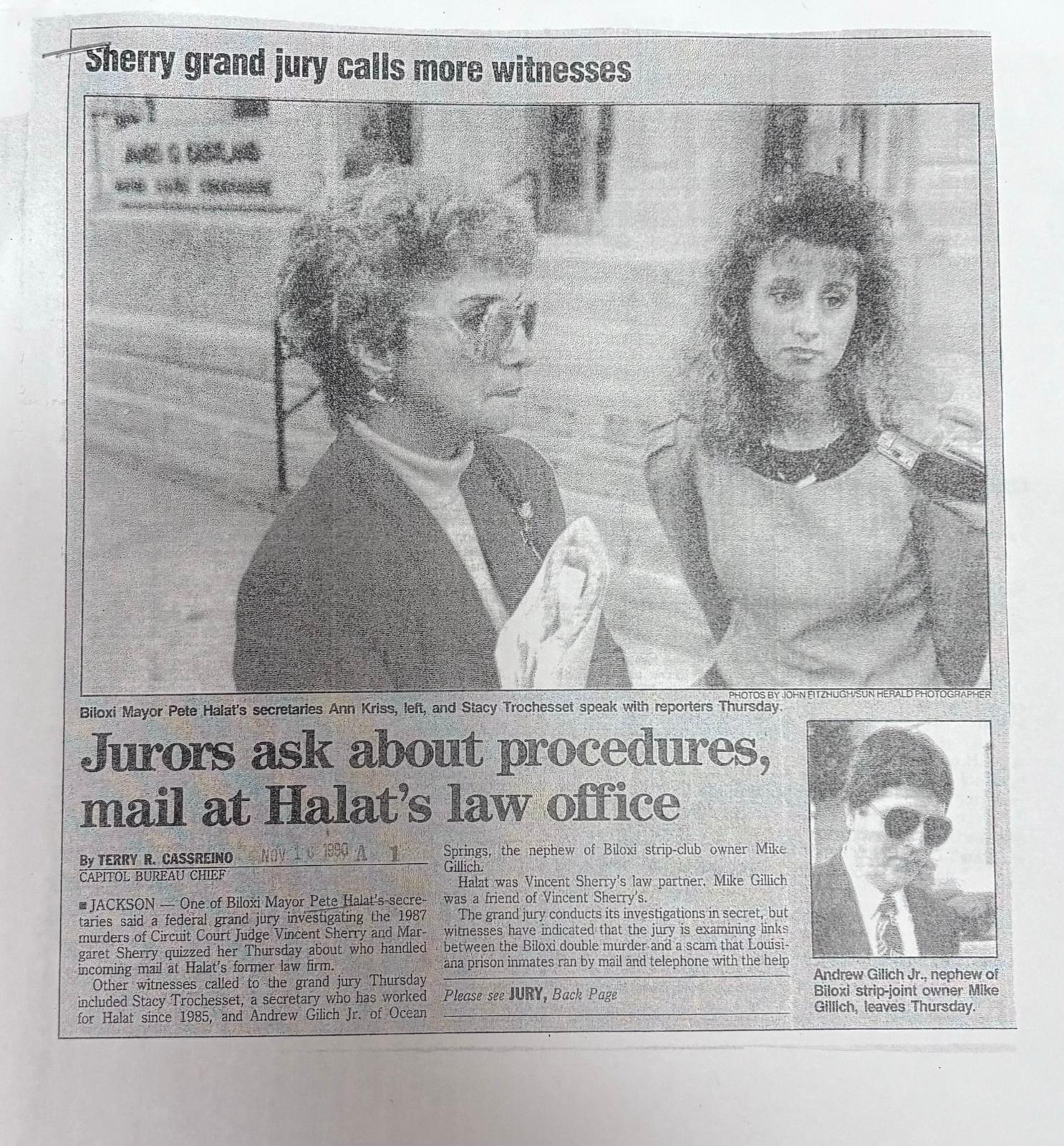
"Andrew Gillich Jr., nephew of Biloxi strip-joint owner Mike Gillich, leaves Thursday."
— November 1990, Federal Grand Jury investigating the Sherry murders
Read that caption again, Reader.
Your mayor — Andrew "FoFo" Gillich Jr. — was called before the federal grand jury investigating the Sherry double murder.
The same grand jury that was "examining links between the Biloxi double murder and a scam that Louisiana prison inmates ran by mail and telephone."
The scam he built the computer systems for.
His face is in the newspaper. Walking out of the courthouse. November 1990. Three years after the murders. The feds wanted to know what he knew.
What did he tell them?
Speak of the devil.
Look who just walked in.
The door swings open. A man in a three-piece suit — gray, pin-striped, expensive — steps into The Dream Room like he owns it. Maybe he does, in a way.
That's Pete Halat.
Watch how the room changes when he enters. The bartender stands up straighter. One of the bouncers nods. Mr. Mike emerges from the back room, all smiles now, hand extended.
"Pete! Get this man a drink!"
They shake hands. Old friends. Business partners. Halat whispers something. Mr. Mike laughs — but his eyes don't laugh. They calculate.
Halat doesn't sit with the regulars. He and Mr. Mike disappear into that back room. The door closes. The deals continue.
That's the man who's going to get two people killed, Reader.
Look at him. Pressed suit. Leather briefcase. Wedding ring. He coaches Little League on Saturdays. He goes to church on Sundays. His law partner is a judge.
And right now he's in the back room of a strip club, counting money from a blackmail scam run by a convicted murderer.
This is Biloxi, Reader. Nothing is what it seems.
Pete Halat.
Attorney at law. Partner in a firm with one of the most respected judges on the Gulf Coast — Circuit Court Judge Vincent Sherry.
Halat handled the legal work. The correspondence. The money transfers. He was the respectable face of a very unrespectable operation.
And he was skimming.
Reader, pay attention now.
Set down your glass. This is important.
This is where people start dying.
The music just changed. Whitesnake. "Still of the Night." The bass line rumbles through the floor like a heartbeat slowing down.
Fitting.
CHAPTER III: THE BETRAYAL
The year is still 1987.
July. August. The Gulf Coast summer is brutal — ninety degrees and ninety percent humidity. The air is so thick you can chew it.
And Kirksey Nix is getting suspicious.
The money isn't adding up.
The Lonely Hearts scam has been running for years. Hundreds of victims. Hundreds of thousands of dollars. But Nix's cut keeps getting smaller.
Where's the money going?
He makes some calls. He asks some questions. He does the math.
Someone is stealing from him.
Pete Halat has a problem.
He's been skimming from the scam. Maybe fifty thousand dollars. Maybe a hundred thousand. Maybe more.
He thought Nix wouldn't notice. He thought a man in prison couldn't count that well. He thought he was smarter than a convicted murderer running a criminal empire from a cell.
He thought wrong.
Nix wants his money back.
Nix wants answers.
And Pete Halat — respectable attorney, law partner to a judge, future mayor of Biloxi — does something unforgivable.
He blames Vincent Sherry.
THE LIE THAT KILLED TWO PEOPLE
When Kirksey Nix demanded to know where his money went, Pete Halat told him:
"Judge Sherry took it."
Vincent Sherry — Circuit Court Judge. Who had nothing to do with the scam. Who knew nothing about the money. Who was just a judge trying to do his job.
Halat sacrificed his own law partner to save himself.
Why would Nix believe it?
Because it made sense. A judge would have access. A judge would seem trustworthy. A judge would be the perfect person to move money through legitimate channels.
And besides — Margaret Sherry had been making noise.
Margaret Sherry.
City councilwoman. Mayoral candidate. Crusader against The Strip.
Come, Reader. Let's leave The Dream Room for a moment. Step outside. I want to show you something.
Walk with me. Down the highway. Past the neon. Past the parking lots full of pickup trucks and out-of-state plates. Keep walking until the air smells less like cigarettes and more like magnolias.
There. City Hall.
The council meeting is just letting out. Watch the doors.
There she is. Margaret Sherry.
Fifty-eight years old. Gray hair she doesn't bother to dye. Reading glasses hanging from a chain around her neck. Sensible shoes. She looks like someone's grandmother.
She is someone's grandmother.
But watch her eyes, Reader. Watch how she stops at the bottom of the steps, turns back toward the building, and stares — like she's memorizing it for battle.
Ethics. Morals. Courage. This woman has all three — and in Biloxi, that makes her dangerous.
A man approaches her. One of the other council members. He's smiling, but it's the smile of a shark.
"Margaret, you need to let this Strip thing go. You're making enemies you don't want."
She doesn't flinch. Doesn't look away.
"Those clubs are destroying this city. Someone has to fight."
"Someone's going to get hurt."
"Is that a threat, Councilman?"
He walks away. Doesn't answer.
Margaret Sherry stands alone on the steps of City Hall. The sun is setting. The neon is flickering to life down on The Strip. Two worlds, Reader — the one that pretends to be civilized, and the one that doesn't bother pretending.
From somewhere — a passing car, an open window — Heart is playing. "Alone."
"Till now, I always got by on my own..."
She's standing in the middle.
And she has six weeks to live.
We can't warn her. We can only watch. The song fades down the street. She doesn't hear it. She's already thinking about her next fight.
She'd been trying to shut down Mike Gillich's clubs for years. She'd been pushing for investigations. She'd been making enemies in all the right places.
If her husband was stealing from the Dixie Mafia? Well, that would explain a lot.
That would make the Sherrys targets.
Nix made the call.
Gillich got the message.
The Sherrys had to go.
September 1987.
Six weeks.
That's all that's left.
Vincent and Margaret Sherry are living their lives. Going to work. Fighting their fights. Planning for a future they'll never see.
42 days.
They don't know there's a contract on their heads.
1,008 hours.
They don't know Mike Gillich is looking for a hitman.
60,480 minutes.
They don't know Pete Halat — their friend, their partner, the man who comes to their house for dinner — sold them out to save his own skin.
3,628,800 seconds.
And every single one of them is ticking away.
Reader.
The undersigned must pause here.
Put down your drink. Look at me.
We are about to witness something terrible. Something that cannot be undone. Something that has been waiting forty years for someone to tell it properly.
Your hands are shaking. I can see them. Mine are too.
This is the part of the story where the music stops. Where the neon goes dark. Where the jokes end and the blood begins.
Finish your bourbon.
You're going to need an empty stomach for what comes next.
Remember the rules: we cannot intervene. We can only watch. We are ghosts walking through a crime scene that hasn't happened yet.
Or has already happened, forty years ago.
Time is strange here, Reader. Past and future bleeding together like spilled whiskey on a bar top. We are standing in both moments at once — the moment before and the moment after. The moment when Margaret Sherry was still alive and the moment when she wasn't.
Both are happening right now.
Come. The night air will clear your head.
We're leaving The Dream Room. Step outside. Feel the humidity wrap around you like a wet blanket. Smell the salt, the exhaust, the jasmine blooming somewhere in the darkness.
It's September now. The calendar pages have turned without us noticing.
The countdown is almost over.
6 weeks ago — Nix made the call.
4 weeks ago — Mike found the hitman.
2 weeks ago — The contract was signed.
3 days ago — Holcomb left Texas.
6 hours ago — He crossed into Mississippi.
2 hours ago — He found the house.
30 minutes ago — He loaded the gun.
Now.
September 14, 1987.
Tonight.
Right now.
CHAPTER IV: THE HIT
September 14, 1987.
Monday night. 9:47 PM.
The air has cooled. The brutal summer is giving way to fall. Hurricane season is winding down. The Gulf is calm.
Vincent and Margaret Sherry are at home.
Their house on Hickory Hill. A nice neighborhood. The kind of place where judges and councilwomen live. The kind of place where people feel safe.
They've just returned from a trip. They're tired. They're getting ready for bed.
They don't hear the car pull up outside.
But we do.
Reader. Grab my arm. Hold tight.
There. At the end of the street.
Do you see it?
Headlights. Cutting through the darkness. Moving slow. Too slow.
A sedan. Dark color — navy or black, hard to tell in this light. Texas plates. Out of state. Out of place. The car glides past the Sherry house once. Twice. Like a shark circling.
On the third pass, it pulls to the curb. Three houses down. Far enough not to be noticed. Close enough to walk.
The engine dies.
The headlights go dark.
Nothing happens.
One minute. Two. The car just sits there. A dark shape in the darkness. Waiting.
Somewhere in the neighborhood, a teenager's radio is playing through an open window. Europe. "The Final Countdown." The synth riff echoes down the empty street.
It's the final countdown...
The song feels wrong here. Obscene, almost. Too triumphant. Too hopeful. It doesn't know what's about to happen. The radio doesn't know. The teenager doesn't know. The crickets don't know. The whole neighborhood is asleep to what's coming.
But we know.
And we can't do a goddamn thing about it.
The car door opens.
Slowly. No dome light — he's disabled it. Professional.
A figure emerges.
Thomas Leslie Holcomb.
Thirty-seven years old. From Texas. A killer for hire.
Watch him, Reader. Study him.
He's not what you expect. Not big. Not menacing. Just... ordinary. Medium height. Medium build. The kind of face that disappears in a crowd. He's wearing a windbreaker and jeans. Could be a plumber. Could be a salesman. Could be anyone.
That's what makes him good at this.
He stands by the car for a moment. Checks his watch. Looks up and down the street. Professionals check their surroundings. Amateurs rush.
Mike Gillich found him through the network. The same network that moves drugs and money and girls through The Strip. The same network that connects every criminal enterprise on the Gulf Coast.
Holcomb has done this before. He'll do it again.
This is just another job.
He reaches into his jacket. Adjusts something.
A .22 caliber pistol. Small. Almost delicate. The kind of gun that doesn't make noise when you don't want it to.
Because attached to the barrel — threaded on tight — is a silencer.
That's the detail that matters, Reader. That's what makes this a professional job. No bang. No flash. Just a whisper and a body. The neighbors will sleep right through it.
Reader. Stay here.
I know you want to follow. I know you want to see. But some things — some things shouldn't be witnessed up close.
We'll watch from the street. From the shadows beneath the oak tree. That's close enough. That's too close.
He walks to the front door. Calm. Unhurried. Like he's selling insurance. Like he's dropping off a package.
He knocks. Three times. Friendly. Neighborly.
Inside, footsteps. Heavy ones — a man's footsteps. Vincent.
The porch light clicks on. Yellow light spills across the welcome mat. Through the frosted glass, a silhouette approaches.
The deadbolt turns. The door opens.
Judge Vincent Sherry stands there in his bathrobe. Sixty-three years old. Wire-rimmed glasses. He squints at the stranger on his porch.
"Can I help you?"
Those are his last words.
The first shot catches him in the chest. A pfft — nothing more. Like someone spitting. Like air escaping a tire.
Vincent staggers backward. His glasses fall. His hand reaches for the doorframe but misses.
The second shot. Forehead. Pfft.
Circuit Court Judge Vincent Sherry — the man who sent criminals to prison, the man who believed in justice — crumples to the floor of his own foyer.
Don't look away, Reader. You came this far. You owe them that much.
Holcomb steps over the body. Moves deeper into the house. Professional.
Footsteps from the back. Lighter. Faster. A woman's voice from the hallway.
"Vincent? Vincent, who was at the—"
Margaret rounds the corner. Still in her travel clothes. Still calling her husband's name.
She never finishes the sentence.
Reader.
Close your eyes.
This is where he gets her.
Pfft. Pfft.
She didn't even see it coming.
Margaret Sherry — ethics, morals, courage — she went without knowing. One moment she was calling for her husband. The next moment she wasn't anything at all.
Maybe that's the only mercy in this whole goddamn story. She never saw the gun. She never saw the stranger. She never had to know that The Strip had finally come for her.
She just... stopped.
Mid-sentence. Mid-step. Mid-life.
But Vincent.
Vincent wasn't so lucky.
He's still on the foyer floor. Still breathing. Chest wound bubbling. Eyes open. Watching.
He heard his wife call his name. He heard the shots. He heard her body hit the floor.
And now Holcomb is walking back toward him.
Slow. Deliberate. The gun still warm.
Vincent Sherry — Circuit Court Judge, husband, father — lies on his own floor and watches the hitman approach. He can't move. He can't speak. He can only watch.
Holcomb stands over him. Looks down. No expression. Just a job.
The gun rises one more time.
Pfft.
Now it's over.
Thirty seconds. Maybe less.
That's how long it takes to end two lives. That's how long it takes to silence the only people in Biloxi who dared to fight back.
Holcomb stands in the foyer. Two bodies at his feet. The house is silent. The television is still on in the den — some Monday night program, canned laughter drifting through the empty rooms.
He checks the bodies. Professional. Picks up the brass casings — four of them, small as shirt buttons. Pockets them. Leaves nothing behind.
Then he walks out the front door. Same pace. Same calm. Pulls it closed behind him.
The porch light is still on. Nobody turned it off. It will stay on all night, all the next day, until their son Eric comes home and finds them.
Holcomb walks back to his car. Doesn't run. Running draws attention. He gets in. Starts the engine. Checks his mirrors — old habit — and drives away. Back to Texas. Back to his life. Eight thousand dollars richer.
Eight thousand dollars. That's what two lives cost in 1987. Four thousand per head.
A judge and a councilwoman, cheaper than a used car.
The street is quiet again.
The crickets resume their song — they never stopped, actually. Crickets don't care about murder. Somewhere down the block, a dog barks once, then stops. A television flickers blue behind a curtain three houses down.
Nobody heard anything. The silencer saw to that. Nobody saw anything. This is Hickory Hill, not The Strip. People mind their own business in nice neighborhoods.
That's how it works in this town.
Reader.
Reader.
I know. I know. I know.
Come here. Sit down. Right here on the curb. I don't care if your clothes get dirty. Sit.
Put your head between your knees. Breathe. In through your nose. Out through your mouth. Again.
Your hands are shaking. So are mine. Look — see? We're both shaking.
You just witnessed a double murder.
Not on television. Not in a movie. You were there. Twenty feet away. Close enough to hear the whisper of the silencer. Close enough to see the porch light flicker when the door closed.
The ghosts of Vincent and Margaret Sherry are inside that house right now. Still warm. Still bleeding. Their blood is soaking into the carpet at this very moment, forming patterns that their son will see tomorrow morning.
And there is nothing we can do about it.
This is what I meant about the rules, Reader. This is why I warned you at the beginning.
We are time travelers, not saviors.
We are witnesses, not warriors.
We cannot change what happened. We can only watch. We can only remember. We can only tell the story so that someone — anyone — understands what this town really is.
And somewhere across town — right now, this very minute — a young man is still sitting at his uncle's bar.
Still watching. Still learning. Still absorbing the family business.
He doesn't know yet. He'll find out from the morning news like everyone else. He'll shake his head. He'll say the right things. He'll go to the funeral.
And forty years from now, he'll be your mayor.
Four terms. Eighty percent of the vote.
And you'll have to look him in the eye, Reader. At ribbon cuttings and town halls and public meetings. You'll have to shake his hand and smile and pretend you don't know what his family did on this quiet street in September 1987.
But you know now.
You were there.
You are now a complicit witness, dear Reader.
You can't unknow what you know. You can't unsee what you saw. The blood on that foyer floor — you watched it spill. The whisper of the silencer — you heard it. The young man at his uncle's bar — you saw his face.
You carry this now. It's yours. It lives in you.
What are you going to do with this knowledge?
Are you going to pretend you never read this? Close the tab, clear your history, go back to your life?
Or are you going to remember?
The next time you see that face on a billboard. The next time you hear that name on the news. The next time someone tells you Biloxi is a nice little beach town with nothing to hide.
You know better now.
You were there.
Their bodies won't be found until the next day.
Sixteen hours. That's how long Vincent and Margaret Sherry will lie on their foyer floor. The television will keep playing. The air conditioning will keep humming. The porch light will keep burning.
And then their son Eric will come to check on them. He'll knock. He'll call out. He'll use his key.
He'll walk through that door and find —
No.
No. We don't need to follow him inside. Some memories belong only to the living. Some screams don't need witnesses.
A judge and his wife. Murdered in their own home. By order of a man who looked like someone's uncle.
Because he was someone's uncle.
Biloxi will never be the same.
That last number is important.
Nothing was taken.
No robbery. No burglary. No attempt to make it look like anything other than what it was.
This was a hit.
This was a message.
And for four years, nobody paid for it.
Reader.
Come away from the window. There's nothing more to see.
The undersigned needs a drink. A real one this time. Something stronger than bourbon. Something to wash the taste of 1987 out of our mouths.
The years are going to start moving fast now. Hold on.
CHAPTER V: THE RECKONING
The investigation went nowhere.
Of course it did.
The Harrison County Sheriff's Office was compromised. The local police were outmatched. The witnesses were scared.
Everyone knew who did it. Nobody could prove it.
The machine protected itself.
But the FBI doesn't give up.
They kept digging. They flipped informants. They followed the money. They waited.
And in 1991, four years after the murders, they made their move.
First to fall: Kirksey Nix and Mike Gillich.
1991. Convicted of travel in aid of murder-for-hire. Federal charges. No state court corruption to worry about.
Nix was already serving life. This just made sure he'd never get out.
Gillich got twenty years. But he had a card to play.
Here's where it gets interesting, Reader.
Mike Gillich became an informant.
1993. 1994. The kingpin of The Strip, the man who hired the hitman, the man who ran the criminals' post office — he started talking.
He gave up Pete Halat.
Pete Halat.
The lawyer who blamed his own partner for money he stole. The man whose lie got two people killed.
By 1989, he was Mayor of Biloxi.
Let that sink in, Reader.
Two years after the Sherry murders — murders he helped cause — Pete Halat was elected mayor of the city where they died.
The same office that FoFo Gilich holds today.
That young man at the bar grew up to sit in the same chair as the man who got his uncle's victims killed.
Biloxi doesn't elect mayors, Reader. Biloxi inherits them.
THE MAYOR WHO CAUSED A DOUBLE MURDER
Pete Halat served as Mayor of Biloxi from 1989 to 1993.
He was convicted in 1997 of conspiracy to commit racketeering and obstruction of justice in connection with the Sherry murders.
He served nearly 16 years in federal prison before his release on April 24, 2013.
He still lives in Ocean Springs, Mississippi. He still maintains his innocence.
1997.
The final trial. The full reckoning.
Pete Halat: convicted. 18 years.
Thomas Holcomb (the hitman): convicted. Life.
Mike Gillich: testified for the prosecution. Got his sentence reduced. Released in July 2000.
Nine years.
That's what Mike Gillich served for ordering the execution of a judge and his wife.
Nine years.
Then he walked free. Back to Biloxi. Back to his family. Back to the same streets where he ran his empire.
He died in 2012. Cancer. At home. Surrounded by family.
A free man.
Reader.
Open your eyes.
The neon is gone. The smoke has cleared. The music has stopped.
No more Mötley Crüe. No more Bon Jovi. No more "Welcome to the Jungle."
Just silence. And the hum of slot machines in the distance.
We're back. 2026.
The Dream Room is a parking lot now. The Golden Nugget is a memory. The Strip has been sanitized, corporatized, casino-fied. The ghosts are still there if you know where to look — but most people don't look.
Most people forget.
The undersigned does not forget.
CHAPTER VI: THE NEPHEW
And now we return to the present.
To 2026.
To a mayor named FoFo Gilich.
Mike Gillich Jr. — the kingpin, the banker, the man who hired the hitman — was FoFo's uncle.
His father's brother.
Blood.
Now, dear Reader, the undersigned must be clear.
FoFo Gilich was never charged with any crime related to the Sherry murders. In the 1980s, while his uncle was running The Strip, FoFo was running Gulf South Analytical Services — the same company that built custom computer systems for his uncle's operation.
The undersigned makes no accusation of criminal conduct.
But the undersigned asks questions.
Why has FoFo been seen with Pete Halat?
Multiple times. In public. Including at the Toronto restaurant in Woolmarket.
Pete Halat — the man whose lie caused a double murder. The man who served nearly 16 years for his role in the conspiracy. The man who was mayor before FoFo was mayor.
What business do they have together?
In 2015, during FoFo's first campaign, someone tried to raise these questions.
FoFo called it "malicious garbage."
He dismissed the questions as "false insinuations."
He refused to debate.
He won with 60% of the vote.
But here's what the Biloxi Historical Society reports about Uncle Mike:
For years, Mike Gillich denied involvement.
For years, he called the accusations garbage.
For years, he maintained his innocence.
Until he didn't.
Until he became an informant. Until he identified the hitman. Until he implicated everyone else to save himself.
So when FoFo calls our questions "malicious garbage" — the same language his uncle used for years before the truth came out — forgive the undersigned for not being reassured.
This isn't the undersigned's research. This is the Biloxi Historical Society documenting the family history.
The silence won.
In 2021, FoFo ran unopposed.
In 2025, he won with 80%.
Nobody asks questions anymore.
Nobody remembers 1987.
Nobody talks about the blood.
THE GILLICH LEGACY
✅ Mike Gillich Jr. ordered a double murder — CONVICTED
✅ Mike Gillich Jr. became an informant — DOCUMENTED
✅ Mike Gillich Jr. served only 9 years — FACT
✅ Mike Gillich Jr. died free in 2012 — FACT
✅ His nephew is now mayor — FACT
✅ That mayor "directed" enforcement against the undersigned — TESTIFIED UNDER OATH
And so here we are.
The undersigned, fighting a federal lawsuit against the City of Biloxi.
The City, led by a mayor whose uncle ordered the execution of a judge who got in the way.
History doesn't repeat. But it rhymes.
Margaret Sherry tried to shut down The Strip.
Margaret Sherry made enemies of the machine.
Margaret Sherry died for it.
The undersigned is making noise about corruption.
The undersigned is making enemies of the machine.
The undersigned is not Margaret Sherry.
Margaret didn't have the internet.
Margaret didn't have federal court.
Margaret didn't have you, Reader — thousands of eyes watching every move this City makes.
The machine can't protect itself anymore.
So here's the message to FoFo Gilich.
To Pete Abide.
To Jerry Creel.
To everyone who thought the undersigned would go away quietly.
MESSAGE TO OUR BOYS
The undersigned knows your history now.
The undersigned has documented it.
The undersigned has published it.
And the undersigned is just getting started.
You poked the bear. The bear has a very long memory.
Thank you for time traveling with me, Reader.
We've seen The Strip in its glory days. We've watched the money flow. We've witnessed the betrayal. We've stood outside the house on Hickory Hill while the blood soaked into the carpet.
We heard "Welcome to the Jungle" when we arrived. We heard "The Final Countdown" before the shots. Now all we hear is silence.
The night was young when we started this journey.
And so were we.
But we've aged forty years in a single reading. We've seen things we can't unsee. We've met people who are dead now — some by bullets, some by time, all of them by the machine.
Now we return to 2026.
To a City that hasn't changed as much as it thinks.
To a mayor with blood in his veins.
To a fight that's just beginning.
Stay tuned, dear Reader.
Part 2 of this investigation will examine FoFo's meetings with Pete Halat. The Toronto restaurant. The connections that persist.
Because the past isn't past in Biloxi.
The past is still running the show.
And the night? The night is still young.
WHY WE'RE TELLING YOU THIS
Now you've seen it, Reader. The Strip. The machine. The blood.
So why now? Why is the undersigned digging through forty-year-old murders?
Because someone poked the bear.
A MESSAGE FOR AARON WILSON
Mr. Aaron Wilson.
The undersigned knows you're reading this. You read everything we publish. You screenshot it. You share it in group chats. You write your little Facebook posts defending the City of Biloxi against the undersigned's federal lawsuits.
You — married to Jacqueline Gilich Wilson. FoFo's niece. You married into the family.
The undersigned told you to let your Gilich relatives know. Let them know that you would be the one to bring our attention to them. That your posts, your noise, your desperate need to defend the indefensible would make us look closer.
You didn't listen.
So here we are.
Mr. Aaron Wilson, claim the credit.
Go to FoFo. Look him in his tired, potato-throated face. And tell him:
"I did this. I'm the reason they're digging. I poked the bear, and now the bear wrote a 15,000-word article about our family's connection to a double homicide."
You did this, Aaron. Own it.
THE DAUGHTER
Gretchen Gilich — the mayor's daughter.
The undersigned has received tips from readers regarding Ms. Gilich. These tips concern matters that, if verified, would be of significant public interest given her father's position.
We are not publishing those allegations at this time.
Why? Because the undersigned has standards. We don't print what we can't verify. Unlike some people's Facebook posts, everything on this website is backed by documentation.
Our investigation is ongoing. When — and if — we have verification sufficient to publish, readers will be the first to know.
Until then: no comment on Gretchen Gilich.
But we are looking.
THE PATTERN
Here's what kills the undersigned, dear Reader.
We barely take a peek into these people — barely — and the amount of stuff we find without even trying is obscene.
✅ The mayor's uncle ordered a double murder — CONVICTED
✅ The mayor was at his uncle's bar, watching and learning — YOU SAW IT
✅ Aaron Wilson (married into the family) writes propaganda defending the City — VERIFIED
✅ The mayor's daughter has allegations our PI is investigating — PENDING
✅ The mayor "directed" enforcement against a federal plaintiff — TESTIFIED UNDER OATH
We didn't go looking for this. We were minding our own business. Trying to build a deck. Trying to live our lives.
They came for us.
And now? Now we're paying attention.
And when we pay attention, dear Reader... we document everything.
THE SCORECARD
SOURCES
Primary Legal Sources
- Fifth Circuit Court Opinion — United States v. Sharpe (1999)
- Fifth Circuit — Sharpe et al. (1993)
- United States v. Nix, 98 F. Supp. 2d 769 (S.D. Miss. 2000)
FBI Sources
Family/Genealogical Sources
- Biloxi Historical Society — Croatian Arrivals from Sinj
- Andrew Gilich Sr. Obituary — Riemann Family Funeral Homes
- Mike Gillich Jr. — Find a Grave
News Sources
- WLOX — Mudslinging suddenly taints Biloxi mayoral election (2015)
- WLOX — Remembering the Sherry Murders (2023)
Books & Media
- Mississippi Mud by Edward Humes (1994) — Pulitzer Prize-winning author
- The Boys from Biloxi by John Grisham (2022) — Fiction inspired by these events
- Dream Room: Tales of the Dixie Mafia by Chet Nicholson — Gillich's own attorney's account
Have Information?
Have information about FoFo Gilich, the Gillich family, or corruption in Biloxi? Contact us.
All communications are confidential.
Legal Disclaimer
This article documents public court records, federal convictions, and genealogical databases. The family connection between Mike Gillich Jr. and Andrew "FoFo" Gilich Jr. is a matter of public record documented by the Biloxi Historical Society and confirmed through obituaries and genealogical sources.
The undersigned makes no accusation of criminal conduct against Mayor FoFo Gilich. He was never charged with any crime related to the Sherry murders.
This article asks questions based on documented evidence. It does not make accusations beyond what is established in public records.
Political commentary on public officials is protected under the First Amendment. See Hustler Magazine v. Falwell, 485 U.S. 46 (1988).