● Tips are now live — tips@peoplevsbiloxi.com
. . .
You just received a text message.
From a number you don't recognize.
Coordinates — not an address. A time — now, not tomorrow, not next week.
And an instruction that makes no sense unless you're walking into something you shouldn't:
Leave your phone in the car.
. . .
It's the kind of text you'd screenshot and send to a friend with a "should I be worried?" attached. The kind that in any normal life, on any normal night, you'd ignore.
But you've been doing this since Part 1.
Following the undersigned into places you shouldn't go. Through time. Through a dark theater. Through a classroom that taught things no university would approve.
And the last line —
The people need you.
That one you can't ignore. Because you know which people. You've met them. You've carried their stories since 1987.
. . .
You went anyway.
You didn't leave your phone in the car.
. . .
The building doesn't have a sign.
No windows on the ground floor. Two cameras above the entrance — small, black, the kind you'd miss if you weren't looking.
You noticed them. You pretended you didn't.
The door is metal. The kind that doesn't echo when you knock — it just absorbs.
. . .
A hallway. Fluorescent light, half the bulbs dead. The ones that work are buzzing — the kind of buzz that lives in your teeth.
It smells like old paper and burnt coffee — not fresh coffee, not the kind that invites you in. The kind that's been sitting on a burner for hours. Scorched. Acidic. The smell of people who forgot they made it.
And underneath that — something electric. Ozone. Like a machine that's been running too long and nobody's checked on it.
The air is cooler than it should be — you feel it on the back of your neck, on the skin between your collar and your hairline.
At the end of the hallway — a door.
Light underneath. Voices. Low.
Not arguing. Discussing. The way people discuss things that scare them.
. . .
You stop.
This isn't 1987. You're not being dragged through time. This isn't a theater — nobody's putting on a show for you. This isn't a classroom — nobody's grading you.
It's January 27, 2026. The present. Real life.
Your heart beats faster. Not in your chest — in your throat.
Your mouth is dry — the kind of dry that no amount of swallowing fixes. Your hands are cold.
When did your hands get cold?
You feel like you shouldn't be here. But you are. And you can't leave — and you shouldn't leave.
The air between you and that door has weight. Like the hallway itself knows what's behind it and is deciding whether to let you through.
Yet you continue.
One step. Then another.
You look behind you — the entrance is already far. The hallway stretches in both directions now, and the door you came through looks smaller than it did a minute ago.
Is this what I should be doing?
The thought arrives fully formed, like it was waiting in the fluorescent hum for you to slow down enough to hear it. The doubt is palpable — it sits in your chest like a swallowed stone.
Yet you march forward.
Because somewhere behind the adrenaline and the buzzing lights and the smell of burnt coffee — you know.
You know that after this meeting, things are going to change. Not for them. For you. You're going to walk back out this hallway knowing something you can't unknow.
And that scares you.
Behind that door, something was found.
Something that connects the Sherry murders to the mayor's office. Something that turns forty years of suspicion into a line — a single, unbroken line — from the Golden Nugget to City Hall.
You don't know this yet. But you will.
. . .
You check your phone. No new messages. No just kidding. No rescue.
You knock.
. . .
The voices stop.
Footsteps. Slow. Deliberate. Someone checking before they open.
. . .
The door opens. Not all the way. A face. The undersigned's face.
But different.
No smile. No performance. No ringmaster energy. No professor's lectern. The undersigned looks like someone who's been awake for thirty hours and found something at hour twenty-six that made sleep impossible.
"You came."
Of course you did. You never failed us before.
A pause. Eyes checking the hallway behind you.
"Get in. Now."
. . .
The door closes behind you. Not a slam — a pull. Deliberate. The lock turns. You hear it — a deadbolt. The old kind. Heavy brass. The kind that doesn't click — it thunks. The kind that means something.
Your phone buzzes in your pocket. You don't check it. Whatever world that was — you just left it.
You're inside.
* eyes adjusting to the light — warmer than the hallway, amber, like someone chose it on purpose *
A room. Not an office — a room. The kind of room that exists because someone needed a place where the walls don't talk. The coffee hits you first — not the hallway version, not the scorched ghost of it. This is fresh. Someone made a pot recently. You can smell the oils in it — dark, almost burnt, the way it smells when people make it strong because they've stopped caring about taste and only need it to work. Underneath: toner, dust, and air conditioning that isn't helping.
One table. Long. Wood. The kind you find in church basements and police precincts. It's covered — manila folders, printouts, a laptop with too many tabs, coffee cups in various stages of abandonment. One still has steam rising from it. Someone has been here for hours. Maybe days.
On the wall behind the table — a board. Corkboard. Photos pinned to it. Names written in marker. And string. Red string. Gold string. Black string. Connecting things that shouldn't be connected.
Three people are already seated. They look up when you walk in. One of them looks away immediately. One of them doesn't blink. One of them is already pulling a folder from under the table.
At the head of the table — one empty chair. Not for you. That's where the undersigned sits.
Your chair is at the other end. The one with the clean space in front of it. No folders. No papers. No coffee. A metal folding chair — the kind that's cold through your clothes the second you sit. The kind that creaks when you shift your weight, so you learn not to shift.
Just a clear surface.
Because everything in this room is about to be passed to you.
. . .
The undersigned walks past you. Sits down at the head. Looks at the room. Looks at you.
"Sit down."
* you sit *
. . .
"Before we start — we need to establish something."
"You've been with me for three parts now. You've traveled with me to 1987. You've sat in the dark theater. You've attended the Academy. You know things about this city that most people will never know."
"You know my name."
"But in this room? You don't use it."
"In this room, nobody uses real names."
. . .
"I'll go first."
"You've known me as the undersigned for three parts. But the undersigned is a public name. A name for articles and courtrooms and federal filings."
"This isn't an article. This is a meeting."
"And in this meeting, I need you to address me properly."
"Badass."
Simple. Clean. Efficient.
"The undersigned appreciates someone who doesn't waste syllables."
A pause. The undersigned tilts their head.
"But good looking is appropriate too, no? It's factual. So we're going with that."
The undersigned doesn't wait for your opinion.
"Bad call, Dear Reader. We'll fix it for you."
"Badass and Good Looking."
The undersigned leans back. For the first time tonight — a smile. Small. Dangerous. The kind of smile that got a hundred thousand people to read about the Dixie Mafia.
"A reader with taste. Finally."
"From now on — Badass and Good Looking. Write it down. Don't abbreviate it."
The undersigned adjusts an invisible tie.
"The undersigned didn't survive 1987, a dark theater, and the Gillich Academy to be called just 'Badass' without the full title."
The room is quiet. The three others are watching. Waiting.
Your hands are flat on the table. You didn't put them there. They just are.
The undersigned — Badass and Good Looking — turns to you.
"Your turn."
"You've been 'the reader' since Part 1. Since 1987. Since you showed up unannounced at the Golden Nugget and I had to drag you through forty years of murder and conspiracy."
"But this is a meeting. And in a meeting, everyone has a name at the table."
"So. What's it going to be?"
"Just 'Reader.' No 'Dear.'"
The undersigned raises an eyebrow.
"Interesting. Dropping the pleasantries. Walking into a secret meeting and going cold."
Badass and Good Looking respects that.
A pause.
"Dear Reader."
The undersigned says it anyway. Doesn't even hesitate.
"Old habits die hard."
From the corner — the faintest sound. Was that a laugh? From the one in the shadows?
"Dear Reader."
The undersigned nods. Slowly. Like you just said the right thing for the first time all night.
"Of course."
"Some things don't change. You were Dear Reader in 1987 when we walked through The Strip. You were Dear Reader in the dark theater. You were Dear Reader in the Academy."
"And you're Dear Reader tonight. In this room. At this table."
"That's not a nickname. That's a rank. You earned it."
Badass and Good Looking reaches under the table. Pulls out a thermos — dented, silver, the kind you'd find on a construction site. Unscrews the cap. The smell of black coffee fills the room before the cup does. Pours it into a styrofoam cup.
Slides it toward you.
"Coffee?"
"Sugar."
The undersigned stares at you. Then at the cup. Then back at you.
"We don't have sugar."
A pause.
"We don't have anything. This is a room with a deadbolt and a corkboard. You're lucky there's coffee."
The cup sits in front of you. Black. Final.
"Zero cals. Stevia."
The undersigned looks at you the way a homicide detective looks at someone who asks for the Wi-Fi password at a crime scene.
"Stevia."
Long pause.
"Dear Reader. We're in a room with no windows, investigating a forty-year pipeline from the Dixie Mafia to City Hall. And you want stevia."
The cup sits in front of you. Black. Non-negotiable.
"No coffee."
The undersigned doesn't move the cup.
"Wrong answer."
Slides it closer.
"This meeting runs on black coffee and public records. You're going to need both."
The cup sits in front of you. You didn't ask for it. It's yours now.
"Just black."
The undersigned looks at you. Really looks. For the first time tonight, something shifts behind the eyes.
"Good."
Slides the cup across the table. No ceremony. No lecture.
"You came ready."
The cup is warm. The coffee is not. You drink it anyway.
. . .
The undersigned watches you look at the cup.
"That was a test, Dear Reader."
A pause. The kind that's earned.
"We drink coffee black here."
. . .
"Good."
Badass and Good Looking stands. Walks to the board. Turns to face the table.
"Now — let me introduce the people who are going to change what you think you know about this city."
. . .
"The one with the folders."
"She doesn't look dangerous, Dear Reader. Glasses. Quiet voice. The kind of person you'd walk past in a courthouse and never notice."
"That's the point."
"The Clerk has been in every records office on the Gulf Coast. Chancery Court. Circuit Court. Secretary of State. Funeral homes. She speaks in case numbers and filing dates."
"She doesn't guess. She doesn't speculate. She finds the document — or she says nothing."
"When the Clerk says 'the record shows' — you listen. Because the record does show. She checked."
You glance at her. She's looking at the folders, not at you. Not at anyone.
"The man at the board. See the string? Red for blood. Gold for money. Black for employment."
It looks like conspiracy madness. It isn't.
"The Mapper doesn't do facts — the Clerk does facts. The Mapper does patterns. He takes what the Clerk finds and asks the question nobody else asks:"
"What does this look like when you see ALL of it at once?"
"He's the one who saw the pipeline. He's the one who said —"
"It's the same guy. Thirty years apart. Same guy."
"You'll understand what that means in about ten minutes."
"And in the corner —"
"Don't look directly at them, Dear Reader. Don't try to count how many."
Your eyes adjust. The far end of the table disappears into shadow. The overhead light doesn't reach that corner — by design. You can make out shapes. More than one. Shoulders. A jawline. The outline of a hand flat on the table. But no faces. Not clearly.
"The Insider isn't one person. It's a seat — and tonight, more than one body fills it. They were inside the machine. Some on the Strip. Some in the buildings around it. Not as visitors. Not as journalists. As part of it. For years."
"They left. Not because they found better jobs. Because they found something worse than unemployment."
"They found what happens when you stay quiet while the building burns around you."
"The Insider speaks in short sentences. Sometimes one word. Sometimes they don't speak at all — just nod. Or shake their head. That's enough."
"When the Insider corrects someone in this room? The room listens."
"Because they were there. We were not."
. . .
"And you."
Five heads turn. A chair creaks — someone leaning forward without realizing.
"You don't need a new alias. You already have one. You've had it since Part 1. Since 1987. Since the Golden Nugget."
"That's who the hundred thousand people outside this room know you as. You're the one they trust. You're the one who went to 1987 and came back. You sat through the Academy and graduated."
"Tonight, you get a promotion."
"Tonight you're not just listening. You're handling the evidence. Every document in this room is going to pass through your hands. You're going to examine it. You're going to see what we saw."
"And when this meeting is over —"
"You carry it out that door."
"Because that's your job, Dear Reader."
"You're the courier."
"You take what's in this room and you give it to the world."
. . .
"And —"
You feel it before you see it. Someone at the far end of the table has been watching you this entire time.
Badass and Good Looking turns to the far end of the table. Past the Insider. Past the shadows. There's someone you didn't notice. Someone who hasn't moved. Someone sitting with their arms crossed.
"Every room needs one."
"The Devil's Advocate doesn't believe us. Doesn't want to believe us. That's the job. Every claim we make tonight — every connection, every timeline, every pattern — the Advocate tries to destroy."
"If the evidence survives the Advocate, it survives a courtroom."
"If the Advocate can explain it away — if it's coincidence, if it's circumstantial, if it's guilt by association — then we don't publish it. We don't take it out that door. We burn it."
"That's the rule. The Advocate has veto power. If they can break it, it's broken."
. . .
Badass and Good Looking stands straighter. The energy shifts. This part isn't performance — it's protocol.
Ground Rules
One. No real names. Badass and Good Looking, Clerk, Mapper, Insider, Advocate, Dear Reader. That's it. What happens in this room is documented — but the people in this room are protected.
Two. Everything the Clerk says is sourced. If she says it, the paper exists. If the paper doesn't exist, she says "unverified." There are no guesses in this room. We don't speculate — we document.
Three. The Insider's identity is protected. Not by courtesy — by law. PeopleVsBiloxi operates as a registered journalistic enterprise — SPJ Member #100082805. Source protection isn't a favor. It's a right under the First Amendment and Mississippi's Shield Law, Miss. Code Ann. § 13-1-253. Anyone who tries to unmask the Insider answers to both.
And to me.
Four. The Advocate can challenge anything. Any fact, any connection, any conclusion. If the Advocate breaks it — we don't publish it. No egos. No exceptions. If it doesn't survive this table, it doesn't leave this room.
"Clear?"
You nod. Your hands are flat on the table — the metal is cold through your palms. You press harder without meaning to, like the table might move if you don't hold it down.
* silence *
"Good."
. . .
"Clerk — start us off."
. . .
Agenda Item I — The Bloodline
THE CLERK
The Clerk opens a manila folder. Places a single sheet on the table. Slides it toward you.
You pick it up. The paper is warm — photocopied recently. Smells like toner. A family tree. Names connected by lines, blue ink pressed hard enough to dent the page. Some of the lines are straight. Some are not. Your thumb settles on a name at the bottom without deciding to.
"For the record."
"The current Mayor of Biloxi is Andrew M. 'FoFo' Gilich Jr. Elected 2015. Re-elected 2017, 2021, and 2025."
"His father was Andrew M. Gilich Sr. — legitimate businessman, Foodland Supermarket, WWII veteran, devout Catholic. No criminal record. Died 2014 at age 91."
"Andrew Sr.'s brother was Michael Joseph Gillich Jr."
* every sound in the room dies *
"Mike Gillich Jr. — also known as Mr. Mike — was the unofficial but de facto kingpin of the Dixie Mafia in Biloxi. The FBI called him 'the criminals' post office' and 'their banker.' He owned the Golden Nugget, the Dream Room, a string of motels, and a bingo parlor — all on or near the Strip."
"On September 14, 1987, Circuit Court Judge Vincent Sherry and his wife Margaret were shot to death in their home. Point blank. Mike Gillich Jr. arranged the hit. He was convicted in 1991. Sentenced to twenty years."
"He served nine. Became a government witness in 1994. His testimony helped convict his co-conspirator — a man named Pete Halat. Gillich was released in 2000. Died of cancer in 2012."
. . .
Your pen hovers over the family tree. Your hand knows something your brain hasn't caught up to yet.
"FoFo Gilich is Mike Gillich Jr.'s nephew."
"The current Mayor of Biloxi is the blood nephew of the man who arranged the execution of a sitting circuit court judge and his wife."
The Clerk closes the folder. Doesn't look up.
"Source: City of Biloxi 2015 inauguration program, Riemann Family Funeral Home obituary, and federal court records."
* the Clerk doesn't editorialize. she never does. *
. . .
"Stop."
The Advocate uncrosses their arms for the first time.
"A man's nephew became mayor. That's what we're opening with? Half the politicians on the Gulf Coast are somebody's nephew, somebody's cousin, somebody's brother-in-law who needs a parking spot. FoFo Gilich didn't choose his uncle. He didn't choose his DNA. He ran for office and won — four times. Are we really starting this meeting by punishing a man for his bloodline?"
. . .
BADASS AND GOOD LOOKING
Badass and Good Looking doesn't flinch.
"Nobody said the bloodline is the crime."
"The bloodline is the address, Advocate. It tells you where to deliver the mail. And when you see where the mail goes — who gets hired, who gets approved, who gets arrested the same week — that's when you stop sleeping."
The Clerk adjusts her glasses.
"The Advocate's objection is noted. And it's fair. FoFo Gilich's lineage is not an accusation. It is a fact. And every fact in this room connects to it."
"The Advocate will understand why before this meeting is over."
* the Advocate says nothing. sits back. arms crossed again. *
Badass and Good Looking reaches into a pocket. Pulls out a pen. Slides it across the table.
"You're going to want to take notes, Dear Reader."
You pick up the pen. It's a cheap ballpoint. The kind they give out at government offices. It works. That's all that matters in this room.
Agenda Item II — The Kirkland File
BADASS AND GOOD LOOKING
Badass and Good Looking stands. Walks to the board. Points to a name connected by black string — employment — to two other names.
"This is where it starts making sense, Dear Reader."
A manila folder slides across the table. Your name isn't on it. Nobody's name is on it. Just a strip of masking tape with three letters: CLK. It's heavier than it looks. The edges are soft — someone has been through this before.
"Open it. Follow along."
You open it. Inside: employment records. City of Biloxi letterhead. Dates. Titles. A résumé that reads like a crime scene. Your pen touches the page before you decide to write.
"Pete Halat was Judge Sherry's law partner. He was also the go-between for the Dixie Mafia's extortion scam — the 'Lonely Hearts' scheme run by Kirksey McCord Nix Jr. from inside Angola Prison. Halat handled the money. When a hundred thousand dollars went missing, Halat blamed Judge Sherry. Nix ordered the hit. Gillich arranged it."
"Halat wasn't arrested right away. The FBI took ten years. In the meantime — Halat ran for Mayor of Biloxi. And won. Elected around 1989."
"Let that settle, Dear Reader. The man who triggered the Sherry murders became the mayor of the city where the murders happened. And the FBI knew. They were investigating him the entire time he held office."
. . .
"Now — here's the name."
"Clifford 'Cliff' Kirkland."
"Kirkland started as a sports editor at the Sun Herald. Local journalist. Biloxi kid. Nothing remarkable."
"Then Pete Halat became Mayor. And Halat hired Kirkland into City Hall as Director of Marketing. Then promoted him to Chief Administrative Officer."
"CAO, Dear Reader. That's the highest non-elected position in the City of Biloxi. The right hand of the mayor."
"Cliff Kirkland was Pete Halat's right-hand man. While the FBI was investigating Halat for murder conspiracy. Kirkland was right there."
"And we have the picture to prove it."
"If you read Part III — and you did, Dear Reader, because you've been here since 1987 — you saw the photograph. Source protected. Five individuals. Look at it again."
"FoFo Gilich — being hugged from behind by Pete Halat. And by his expression, Dear Reader, the man is in ecstasy. Pure joy. The nephew of the kingpin, embraced by the co-conspirator who triggered the Sherry murders."
"And to the left of the frame — standing right there, in the same photograph, in the same room, at the same moment —"
"Cliff Kirkland. Now a convicted pedophile. Thirty-five years."
. . .
Badass and Good Looking turns to the Advocate.
"Advocate. Do you dispute the palpable joy in that picture?"
. . .
The Advocate opens their mouth. Closes it. Opens it again.
"No."
"I can't dispute a photograph."
"No. You can't."
Badass and Good Looking reaches into a folder. Pulls out a print. Slides it across the table toward you.
"Hold it, Dear Reader. Look at it."
You hold it. Glossy. The kind of print that picks up fingerprints. Yours is already on the corner.
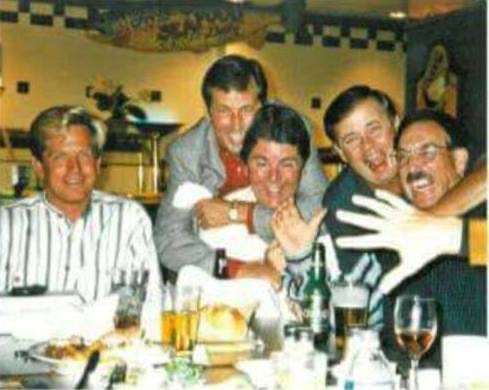
Source protected. Five individuals. One frame.
"Left side of the frame — Cliff Kirkland. Convicted pedophile. Thirty-five years."
"Center — FoFo Gilich. Being embraced from behind by Pete Halat. Look at the face. That's not a handshake at a fundraiser. That's joy."
"That's the pipeline in a single image. Pass it back."
The Mapper taps the board. The string connecting Halat to Kirkland to FoFo isn't theoretical. It's on the table. Five people. One frame.
. . .
"Halat was convicted in 1997. Eighteen years federal. Kirkland moved on — ran a nonprofit called Main Street Biloxi. Downtown development. Clean work. The kind of career you build when the last thing on your résumé is right-hand man to a convicted murderer."
"And then — 2015."
"FoFo Gilich becomes Mayor."
"And FoFo's first move? One of his first hires?"
"He hires Cliff Kirkland. As Chief Innovation Officer."
* the Mapper's pen stops *
"The nephew of Mike Gillich Jr. hired the former right-hand man of Pete Halat. The man whose uncle conspired with Halat to murder a judge — hired the man who served under Halat during the conspiracy."
"Nobody asked why. Nobody in Biloxi reported it. Nobody connected the names."
"We did."
. . .
"One more thing."
The Insider hasn't moved. But the voice is different now. Harder.
"When Kirkland was brought on, somebody in Human Resources pulled his background. Standard process. They found the Halat connection. A memo went up. To the Mayor's office."
"Nothing happened."
"The memo went up. And Kirkland stayed."
* the room absorbs this *
. . .
"Objection."
"Cliff Kirkland ran Main Street Biloxi for years after Halat went to prison. Downtown revitalization. Clean work. Public record. Maybe FoFo hired him because he was the most qualified person in the room — not because of some invisible thread you're trying to spin between 1990 and 2015."
"Kirkland was his friend. People hire friends. That's not a conspiracy. That's Mississippi."
Badass and Good Looking turns from the board. Slowly. The chair scrapes the floor. Nobody else moves.
"Friend?"
* the air in the room shifts — you feel it, like someone opened a window that wasn't there *
"He abused his own friend's daughters. That's what your friend did."
The voice isn't raised. Not yet. But it's changed. The performance is gone. This is personal now.
. . .
"And don't say friend like it's casual. Look at the photo."
Badass and Good Looking jabs a finger at the corkboard. The photo rattles against the pin.
"That's Kirkland. That's Peter Halat. That's FoFo. Same frame. Same table. They're beyond friends."
"FoFo himself said it — thirty years of friendship. Thirty years."
The voice is louder now. Not shouting — but the room is small and it fills every corner of it. The Clerk stops writing. The Insider looks up for the first time.
"And he didn't know?"
"The man's family owned strip clubs on the Strip. He's a mayor. He didn't get where he is by not knowing things."
You feel your jaw tighten. The coffee in your cup has gone still — no steam, no ripple. The air in the room is thick now. The kind of thick that sits on your shoulders.
. . .
"That's — you're conflating —"
The Advocate's voice cracks on the second word. Not much. Just enough that everyone hears it.
"I'm not conflating anything."
Badass and Good Looking is standing now. Both hands on the table. Leaning forward. The folders shift under the weight.
"FoFo Gilich could have hired any of ten thousand people in Harrison County for that role. He hired the one man on Earth who served directly under Pete Halat during the years the FBI was building a murder case against him. His thirty-year friend. Who then molested children."
"One man. Out of ten thousand. That's not a second chance, Advocate. That's a reunion."
* silence. the AC hums. someone's pen rolls off the table and hits the floor. nobody picks it up. *
* the Advocate opens their mouth. closes it. *
That's how this room works, Dear Reader. When the Advocate breaks — it stays broken.
. . .
Badass and Good Looking doesn't sit back down. Not yet.
"But nonetheless — they were still arrested. Both of them. Both for being pedophiles. One is the mayor's own cousin. The other, his best friend."
"What do we see here?"
The question hangs. Not rhetorical — surgical. Aimed at you.
"How is that not a pattern?"
* nobody answers. because nobody can. *
Agenda Item III — December 2019
THE MAPPER
The Mapper speaks for the first time. He doesn't stand. He just turns the corkboard around.
The board faces you now. Up close, from this angle, it's different. The photos are sharper. The dates are in thick marker — red circles, black arrows. Your eyes trace a line before your brain does. You lean forward. Your elbows are on the table. You didn't put them there.
"One week. Two arrests. Four days apart."
"December 13, 2019. Michael Joseph Gillich III — Mike Gillich Jr.'s son, FoFo's first cousin — arrested. Credit card fraud. Methamphetamine possession. Bond set at thirty thousand dollars."
"December 17, 2019. Cliff Kirkland — FoFo's Chief Innovation Officer, Pete Halat's former CAO — arrested. Two counts of child molestation."
"Two men. Both inside FoFo's orbit. Both arrested the same week."
The Clerk slides two sheets of paper across the table. Side by side.
You look down. Two arrest reports. Two dates. Four days apart. The paper is cold. The ink is official. You set them next to each other and the dates stare back at you: December 13. December 17.
"Keep those in front of you, Dear Reader. You'll need them."
. . .
The Mapper taps the board.
"Red string is blood. I've got it running from Mike Gillich Jr. down to Michael III. Father to son."
"Black string is employment. I've got it running from Pete Halat to Cliff Kirkland, and then from FoFo to the same Cliff Kirkland."
"Gold string is money. That's what I can't trace yet. But the other two are enough."
"Both strings lead to FoFo."
"We don't know if the arrests were connected. Could be coincidence. Could be a broader investigation. What we know is the timing — and the orbit."
"Both men were in FoFo's circle. One by blood. One by paycheck."
. . .
The Advocate gestures toward you. Toward the two arrest reports sitting in front of you.
"Dear Reader — slide those over to the Advocate."
You do. The two sheets cross the table. The Advocate picks them up. Studies them. Holds one in each hand like they're weighing something.
The Advocate leans forward. This is the one they've been waiting for.
"Four days. In a city of forty-six thousand people. You know how many arrests happen in Harrison County in any given week? Dozens. You're connecting two arrests because both men knew the same mayor."
"Show me a warrant. Show me a wiretap. Show me a shared attorney. Show me anything that proves these two arrests were coordinated."
"You can't. Because you don't have it. That's not a pattern. That's a calendar."
. . .
THE MAPPER
The Mapper stops. Pen frozen over the board. Looks at the Advocate for a long time.
You notice something. The Advocate isn't performing. No crossed arms. No dramatic pause. Just calm. The calm of someone who knows they've already won this one.
"I want to argue with you."
Pause.
"But I can't. Not on the timing alone. Four days apart — I can't prove those arrests were connected. I don't have a wiretap. I don't have a shared informant. I have proximity and I have timing. And timing isn't proof."
. . .
BADASS AND GOOD LOOKING
Badass and Good Looking looks at the Advocate. Then at the Mapper. Then back at you.
"The Advocate takes Item III."
"The timing is noted. The four-day window is documented. But we cannot prove the arrests were connected. So we don't claim they were."
"That's how this room works, Dear Reader. When the Advocate breaks it — it stays broken."
You set down the pen. The arrest reports in front of you look different now — just paper. Dates. Ink. Nothing proven.
* the Advocate nods. once. the first time anyone in this room has seen them look satisfied. *
"But Advocate —"
"The timing didn't prove connection. It didn't disprove the orbit either. And the orbit is what we're building. One item at a time."
* the Advocate's satisfaction fades. slightly. *
Agenda Item IV — The Son of the Kingpin
THE CLERK
The Clerk pulls a second folder. This one is thicker.
"Michael Joseph Gillich III. Born approximately 1967, Biloxi. Son of Mike Gillich Jr. and Marlene Redding Gillich. Two sisters — Marlene Cecile and Tina Rose. Married Sandra Leigh Suarez."
"He's FoFo's first cousin. The mayor's cousin. His father was FoFo's uncle."
The Clerk pulls a photograph from the folder. Slides it face-up on the table.
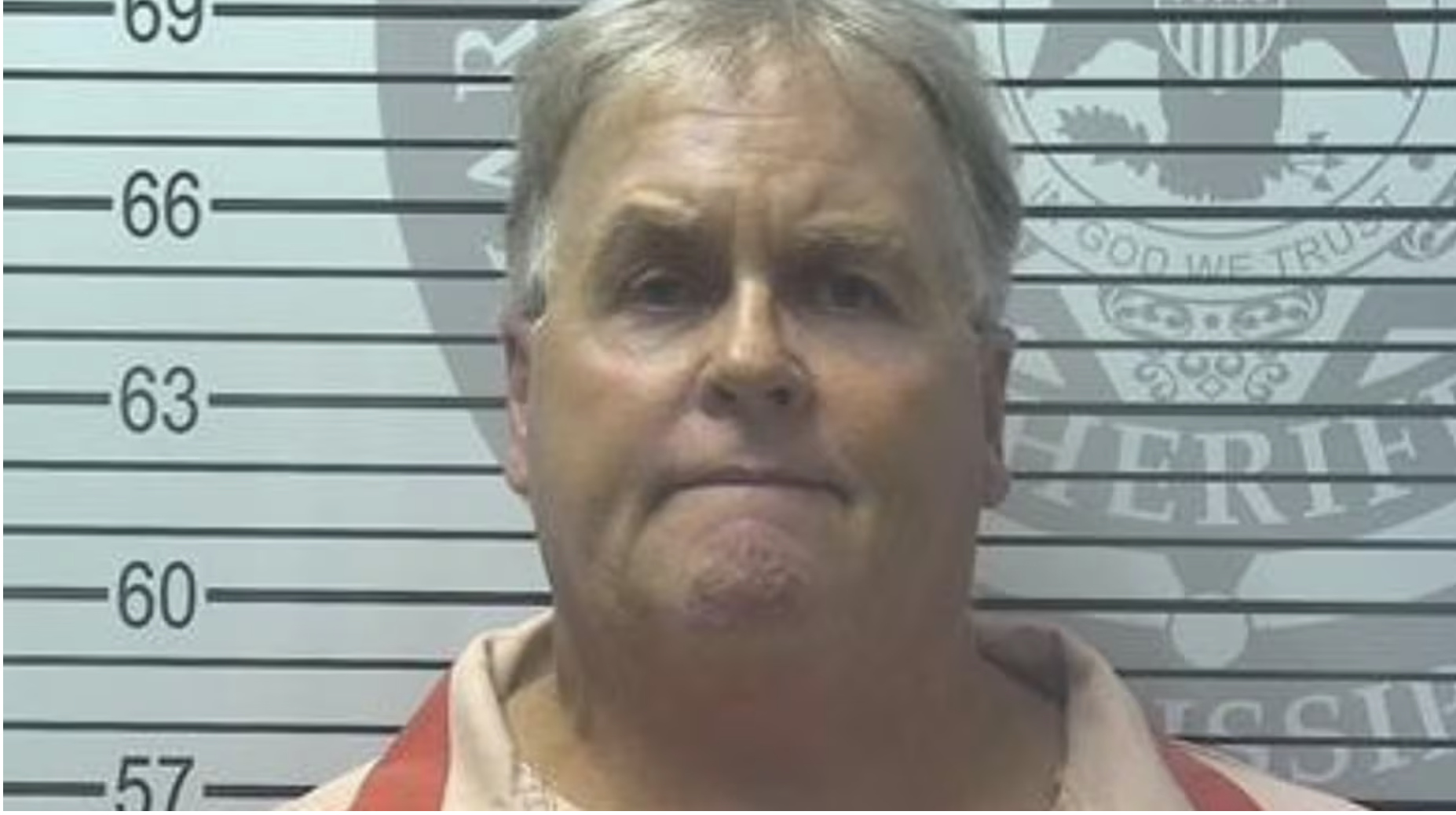
MICHAEL JOSEPH GILLICH III — BOOKING PHOTO
"Booking photo. That's the mayor's cousin."
. . .
"The record shows Michael III had business activity on the Strip. After his father died in 2012 and the old clubs shut down, Michael III took over Le Bistro — the club his father's portfolio had operated for years — and rebranded it. In 2013, he formed Star Lounge LLC with the Mississippi Secretary of State. Same Strip. Same family. New name."
"In May 2018, the Board of Zoning Adjustments approved his application — Case 18-020 — for a venue at 176 Veterans Avenue."
The Clerk pulls a stapled document from the folder. Slides it to you.
You hold it. BZA minutes. Case 18-020. The applicant's name is right there — Michael J. Gillich III. The address is right there — 176 Veterans Avenue. You don't need the Mapper to draw the string. You can feel it in your hands.
"176 Veterans Avenue is on the Strip. The same Strip his father ran."
"The venue never fully materialized. But the application was approved — during FoFo's administration."
. . .
THE MAPPER
The Mapper leans forward.
"The father ran the Strip in the '80s. The son tried to open a club on the Strip in 2018. Same street. Same family. Thirty years apart."
"And the cousin was the mayor who approved the zoning."
. . .
The Clerk continues.
"After the December 2019 arrest for fraud and methamphetamine, additional charges followed. On August 25, 2025, Michael Gillich III was convicted of sexually abusing a child. Fox10 TV reported the conviction."
"On September 10, 2025, he was sentenced to twelve years in the Mississippi Department of Corrections. WLOX reported the sentencing."
"The son of the Dixie Mafia kingpin is now a convicted child sex offender serving twelve years."
* silence *
"The father arranged the execution of a sitting judge. The son sexually abused a child. And the cousin is the mayor."
"That's the Gillich family tree, Dear Reader."
. . .
The Advocate speaks. Quieter now.
"A man opened a business on a public street. He filed paperwork with the Secretary of State. He applied for zoning and got it through the normal process — BZA Case 18-020, public hearing, public vote. And then he committed a crime — years later — and was convicted."
"That's the justice system working. Not a pipeline."
THE MAPPER
The Mapper taps the board. Once.
"The BZA approved it during FoFo's administration. The applicant was FoFo's first cousin. And the address — 176 Veterans Avenue — is on the Strip. The same Strip where Michael's father ran the Dixie Mafia."
"Nobody's saying he can't open a business. We're saying the son of the kingpin tried to reopen the family's street — and the nephew of the kingpin was the mayor who presided over the approval."
. . .
THE CLERK
The Clerk doesn't look at the Advocate when she speaks.
"And then in August 2025, the same Michael Gillich III was convicted of sexually abusing a child. Twelve years in the Mississippi Department of Corrections. The justice system worked, Advocate. But the bloodline is what brought him to the Strip in the first place."
* the Advocate looks at their notepad. doesn't write anything this time. *
. . .
The Insider hasn't spoken during this item. Until now.
"You're talking about Star Lounge like it was a business plan. Like he filed paperwork and applied for zoning and that's the story."
"It's not the story."
* the room goes still *
"Mike 3 — that's what people called him — was infamous on the Strip. Going out with the strippers. Paying them. Recording them."
"And there were reports of blackmailing. Not speculation. Reports."
"His uncle — Mike Jr. — was the same way. Known for going out with several girls. That was the Gillich way. Own the clubs. Use the girls."
. . .
"How do you know this?"
. . .
The dark corner doesn't move. Nobody in it looks at anyone. The silence in the room has a different weight now. Heavier. More personal.
"Because I grew up there."
. . .
* nobody breathes *
"I grew up on that Strip. I danced in those clubs. I was in and out of those buildings — through the back doors, through the dressing rooms, through the hallways nobody sees."
"I knew every girl who walked into those rooms. I knew what they looked like before. And I knew what they looked like after."
"I saw what the Gillich family did to people. I watched it. Year after year. And the same last names kept showing up — on the doors, on the licenses, on the payroll. Always the same names."
"The Strip didn't end. It just changed who was watching."
The Clerk stopped writing. Nobody is looking at anyone.
Nobody moves. So you do. You reach for the thermos. Pour water into an empty cup. Your hands are steady — the rest of you isn't. You slide it across the table toward the dark corner.
Nobody in the shadow looks at you. But a hand reaches out from the darkness. Takes the cup. Holds it.
Doesn't drink.
. . .
"And you want to know about the Mayor?"
"FoFo was different. Everybody knew. It was speculated openly — by everyone — that he may be homosexual."
"He wasn't like his uncle. He wasn't like Mike 3."
"But here's what nobody talks about."
"The uncle ran the girls. The cousin exploited the girls. Recorded them. Blackmailed them. And the nephew — the one everybody speculated about — became the mayor who oversaw the same Strip where all of it happened."
"Different appetites. Same address. Same family. Same silence."
. . .
The Advocate speaks carefully.
"A man's sexuality is not evidence of anything. It's not relevant to this meeting."
"You're right. It's not."
"What's relevant is that three generations of one family operated on the same Strip — and every generation had a different way of using the people on it. The uncle used the girls for money. The cousin used them for leverage. And the mayor used the silence for power."
"I knew those girls. I watched them disappear into those rooms. And nobody — nobody — asked what happened to them. Not then. Not now. Not until this table."
* the Insider goes quiet. stays quiet for the rest of this item. *
. . .
Badass and Good Looking reaches under the table. Pulls out a book. Worn spine. Dog-eared. The cover is creased from being opened too many times in the same place. Sets it on the table with a sound that's louder than it should be.
You lean forward. The title is in bold print across the cover:
THE DEAD LINE: CONFESSIONS OF A DIXIE MAFIA ASSASSIN
by T.A. Powell
You've never seen it before. But the spine tells you someone in this room has read it cover to cover. More than once.
"Before the Advocate says anything — before anyone in this room questions what the Insider just told you — let me introduce someone."
"Angela Ward."
"Her mother's name was Georgia. In the book, they called her Susie. And her daughter — Angela — in the book, they called her Baby."
"Susie and Baby. Mother and daughter. Both in the book. Both on the Strip. Both real."
"Georgia was trafficked from Ohio at fourteen years old. Brought to Biloxi. Made to work."
"And then her daughter — Angela — once she turned seventeen, she started working as a stripper at the Dream Room. Mother at the Horseshoe. Daughter at the Dream Room. Both Mike Gillich's clubs."
The room doesn't react. It absorbs. Like it's been absorbing everything tonight.
"Mother and daughter. The mother trafficked at fourteen. The daughter stripping at seventeen. Same Strip. Same family running it."
"This isn't speculation. This isn't the Insider's word against the Advocate's objection. This is in The Dead Line: Confessions of a Dixie Mafia Assassin by T.A. Powell. Published. Documented. On the record."
"And I talked to her. Angela. Several times. And I talked to Powell."
"These are real people we talked to. Not footnotes. Not rumors. Real people with real names who told us what happened to them on that Strip."
. . .
Badass and Good Looking taps the book on the table. Twice. Hard.
"We're reading her book. Cover to cover. And we are in talks with the author. More meetings are coming. This isn't the last time you'll hear these names in this room."
"Powell also has MISSISSIPPI CONFIDENTIAL documents as of 2020 — including what she describes as never-before-seen FBI documents that were believed to have gotten the Sherrys murdered."
The room shifts. The Mapper looks at the Clerk. The Clerk looks at the Insider. Nobody looks at the Advocate.
"The FBI files. The ones Powell says were buried. The ones nobody was supposed to see. She has them. And we are in contact."
. . .
"These people — Georgia, Angela, the women on that Strip — they demand their voices to be heard. Even if from beyond the grave."
"T.A. Powell. We side with the author."
. . .
"And Angela remembers."
Badass and Good Looking leans forward. The voice drops. Not for drama — for weight.
"Her mother Georgia would start her shift at the Horseshoe at 7 PM. Every night. And on the way, she'd drop Angela off at daycare."
"Angela was seven years old."
Your pen stops mid-stroke. Seven. You look down at what you just wrote and the number sits there on the notepad like a wound. Your throat tightens. The coffee in your cup is cold but you drink it anyway — just to have something to do with your hands.
"And many times — on the way — she saw him. FoFo. In the parking lot. The Le Bistro parking lot. The Horseshoe parking lot. Delivering drugs to her mother."
"Georgia was addicted. FoFo was her supplier. And according to Angela, he was there almost every single day. Waiting at the parking lot. The handoff was routine."
"Some days Georgia couldn't drop Angela off at daycare first. She'd have to meet FoFo before the shift — and the girl was in the car. Seven years old. Watching through the window."
The room is so quiet you can hear the AC cycling. Nobody is looking at the board anymore. They're looking at the table.
"Drugs her mother used. Drugs her mother sold to clients. Angela accounts all of this in detail — the parking lots, the timing, the handoffs. And one thing she remembers very clearly —"
"FoFo would complain. About Georgia bringing her. Don't bring the girl. She was seven years old, and the man delivering drugs to her mother didn't want the child to see it."
. . .
"According to Angela — he knew what he was doing. He knew it was wrong. And he did it anyway. For years."
"These are witness accounts, Dear Reader. Not allegations. Not inferences. According to Angela — a seven-year-old girl watched the future mayor of Biloxi deliver drugs to her mother in a strip club parking lot. And she remembers."
. . .
Badass and Good Looking pauses. Looks at the room. Then at you.
"And before anyone questions her — we did. We questioned her harder than anyone in this room would."
"We had to ask uncomfortable questions. The kind that make you hate yourself for asking."
"How much did you charge a customer. Where did you meet them. How was the staff interaction — who managed you, who watched, who collected. How long did it take. The people. The modus operandi. How much were you paid. How much did the house keep."
The room is still. Nobody interrupts. You don't want to hear this. But you need to.
"She answered every single one."
. . .
"On a given day — Angela reported she was with one to ten men. Every day. Not sometimes. Not on busy nights. Every day."
The Clerk's pen drops. Not sets down — drops. It rolls off the table and hits the floor and nobody picks it up. Her hand stays where the pen was. Hovering. The glasses come off. She pinches the bridge of her nose. The woman who speaks in case numbers and filing dates — the woman who never editorializes — is pressing her eyes shut.
Your pen freezes. You stare at the number you just wrote. Ten. You underline it. Then you scratch through the underline because it's not enough. Nothing on this notepad is enough for what you're hearing.
Badass and Good Looking stops. Not a pause for effect. Not a beat for the room to absorb. The voice just — stops. Both hands on the table. Head down. When the voice comes back, it's different. Quieter. The investigator is gone. The person is here.
"Can you imagine?"
"Ten people. In one day."
The words hang in the air like smoke. Nobody moves. You look toward the dark corner. The shapes in the shadow are looking at the wall. Not avoiding your eyes — looking at something that isn't there anymore. Something thirty years away.
"That's not a statistic, Dear Reader. That's a human being. That's a girl who started at seventeen. Whose mother started at fourteen. And every single day, that girl walked into a room and her body became the product. One man. Then another. Then another. Until the number didn't matter anymore — because the number was just the day."
* the AC cycles. the fluorescent above flickers once. nobody notices. *
. . .
"She charged around three hundred dollars. Per customer. That's what the rate was."
"But here's where it becomes a machine, Dear Reader."
"They took most of it. The house. The managers. The family. Most of that three hundred dollars never stayed with her. She worked. They collected."
You feel your jaw tighten. The pen is pressing so hard the ink bleeds through to the next page. You ease up. You don't ease up enough.
"And then — whatever was left — they took that too."
"They'd fabricate issues. Invent problems. You owe for this. You broke that. There's a fee for this service. And then their friends — people connected to the operation — would show up offering services or protection. At a cost. Always at a cost."
"The girl works. The house takes the money. And then the house's friends take whatever the house left behind."
"That's not employment. That's not even exploitation. That's a closed loop. The money comes in through her body and it leaves through their hands. Every dollar. Every day. Every man."
The Mapper's hand is flat against the corkboard. Not pointing at it. Holding it. Like the board might fall if he lets go. His jaw is set. The kind of set that keeps words from coming out that shouldn't.
The Clerk makes a sound. Small. Not a word — not even close to a word. The kind of sound that escapes before you can stop it. Her glasses are back on but they're fogged. She wipes them with the cuff of her sleeve. Puts them back on. Takes them off again. Her hand goes to her mouth.
She's crying. The Clerk — the one who doesn't editorialize, the one who speaks only in case numbers and filing dates, the one who says "the record shows" and never says what she feels — is crying at the table. Silently. The way people cry when they've been trained not to.
Nobody says anything. Nobody looks at her. That's respect in this room.
The Insider hasn't moved. But you hear breathing — sharp, controlled, the kind that comes from someone trying very hard not to react to something they already know.
. . .
The Advocate speaks. Not objecting. Not challenging. Just — speaking.
"It's hard to be on their side."
Pause. Long.
"Dammit. It's hard to be on their side."
Badass and Good Looking doesn't respond. Doesn't need to. The Advocate just said what the room was thinking. The job is to break the evidence — not defend the people behind it. But right now, in this room, with the Clerk wiping her glasses and the Insider holding their breath — the line between those two things just disappeared.
. . .
"Then we asked her again the next day. Same questions. Different order. Different angle. Tried to catch a contradiction. Tried to find a gap. A number that didn't match. A name that shifted. A detail that moved."
"She survived our best attempts at contradiction. Every time."
"She recalled names. The manager. Staff. People we'd never heard of. Details about the Le Bistro itself — the layout, the routine, the way it operated."
"And here's what sealed it for us — Le Bistro was hard to find records for. Almost impossible. We nearly couldn't verify what she was telling us. It took effort — real digging — to find documentation of things that were living in her head."
"But they exist. The records exist. What she remembered checked out."
"When a witness gives you details you can't easily find — and then you find them anyway — that's not a fabrication. That's a memory that survived because the person lived it."
. . .
"Her mother was a stripper and a prostitute. And so was she. That's not an accusation — that's what happened to them. That was the life the Strip gave them."
"And she has evidence. Angela still has photographs — nudes, lingerie pictures — taken by the staff of the Dream Room. Of herself. At that location. Taken by the people who ran the club."
The Clerk's pen stops. The Mapper turns from the board. Even the Advocate shifts in their chair.
"The facts are completely undisputable. Angela Ward is a reliable witness. We vetted her. We challenged her. We made her tell it twice. And the story didn't change — because it's not a story. It's what happened."
. . .
"Two generations of the same family — exploited. By two generations of the same family — profiting."
The Advocate stands up. Chair scrapes the floor. Hard.
"No."
"No. I'm not sitting through this."
"You're building a case — an entire investigative series — on the word of one woman. A woman who — by her own admission — was a prostitute. A stripper. An addict's daughter raised inside the same machine you're claiming to expose. That's your star witness? That's what you're staking this publication on?"
"Who is Angela Ward? Has anyone in this room — besides you — ever heard that name before tonight? Can anyone in this room verify a single thing she's told you? Where is she? Where does she live? What does she do? What's her record? What's her motive?"
"Because from where I'm sitting — you found a woman with a tragic story and a grudge, and you built a cathedral around it. You took her word and turned it into a timeline. You took her memories and called them evidence. You asked her leading questions and called the answers corroboration."
"Do you understand the stakes? You are accusing a sitting mayor — by name — of drug trafficking. Of running a prostitution pipeline. Of being an accessory to human trafficking. Based on one woman's account from thirty years ago."
"Where's the police report? Where's the arrest record? Where's the sworn affidavit? Where's the second witness? Where's anything besides Angela?"
"You've given this room tears. You've given this room outrage. You've given this room a mother at fourteen and a daughter at seventeen and enough horror to fill a book."
"But you have not given this room evidence. And without evidence, this isn't journalism. It's a liability."
The room doesn't breathe. The Clerk's pen is flat on the table. The Mapper has turned from the board. From the dark corner — nothing. Not a sound.
Badass and Good Looking doesn't respond immediately. The jaw sets. The knuckles go white against the table edge. The eyes don't blink. Not once. The silence stretches — three seconds, five seconds, long enough that the Advocate starts to sit back down.
Then the hand moves. Into the folder. Slowly. Deliberately.
"You want fucking documents, Advocate?"
Three stapled pages hit the table. Hard. The sound cracks through the room like a gavel.
"You dispute Angela? Fine."
Badass and Good Looking shoves the pages across the table — not toward the Advocate. Toward you. Past the coffee cups, past the notebooks, past the Clerk's dropped pen. The pages stop in front of you.
"Read it. Out loud. So the Advocate can hear it from someone other than me."
. . .
You pick it up. Your hands are not steady. The paper is thick. Official letterhead. You look at the Contractor. The Contractor nods once. Read.
You clear your throat. The sound is too loud in this room.
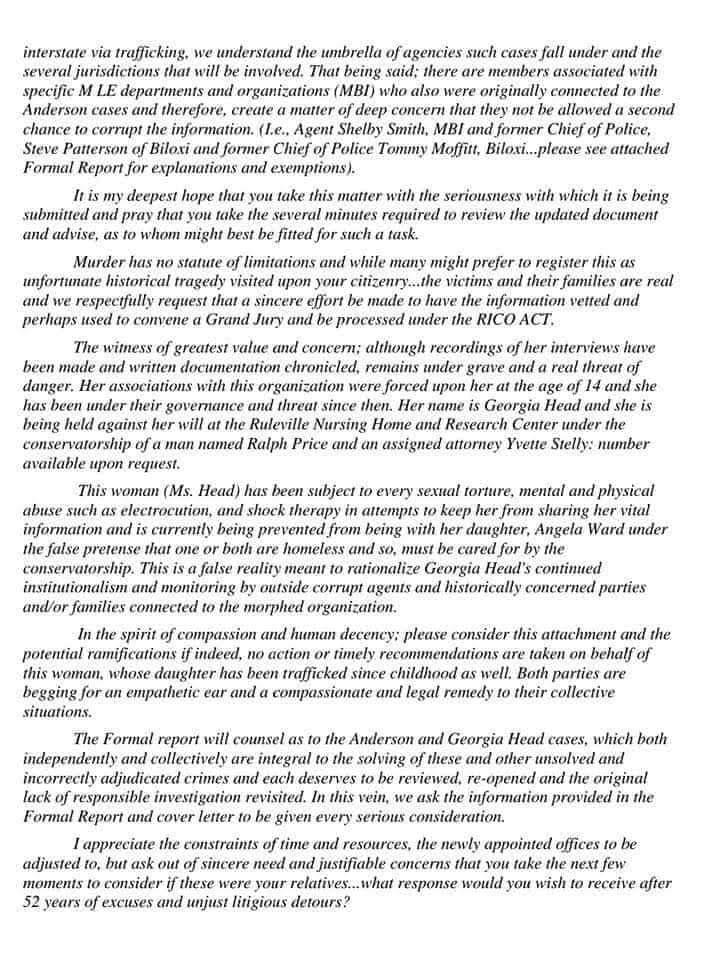
T.A. Powell letter — Page 1 of 3 — December 13, 2019
"December 13, 2019. Brownstone Literary Works, LLC. To Governor-Elect Tate and Jackson County District Attorney Angel Myers-McIlrath."
Your voice sounds wrong in here. Too normal for what's on the page.
"This formal letter is to request your personal attention to the Phyllis Anderson Cook cases and the critical Fact/Material Witnesses — Georgia Head and Angela Ward."
You look up. The Advocate is staring at you. You keep reading.
"Connected cases include... the Judge Vincent and Margaret Sherry murders of Biloxi, 1987... all by members of the Dixie Mafia."
"Keep going. The next part."
"Georgia Head... a trafficked commodity, sold to members of the Dixie Mafia as a child and became what is referred to today as a Monarch Slave."
Your voice cracks on child. You didn't expect that. The Clerk's hand is over her mouth. From the dark corner — a sound. Something between a breath and a word. You don't look.
"A formal report was given to Atlanta FBI headquarters on November 8, 2019... recommended by Judge Daniel D. Guice III."
"The FBI. A judge. The Governor. That's who Powell went to — before we ever spoke to Angela. Read them page two."
"A letter doesn't —"
"I'm not done. And neither is the reader."
The Advocate sits back down. You turn the page.
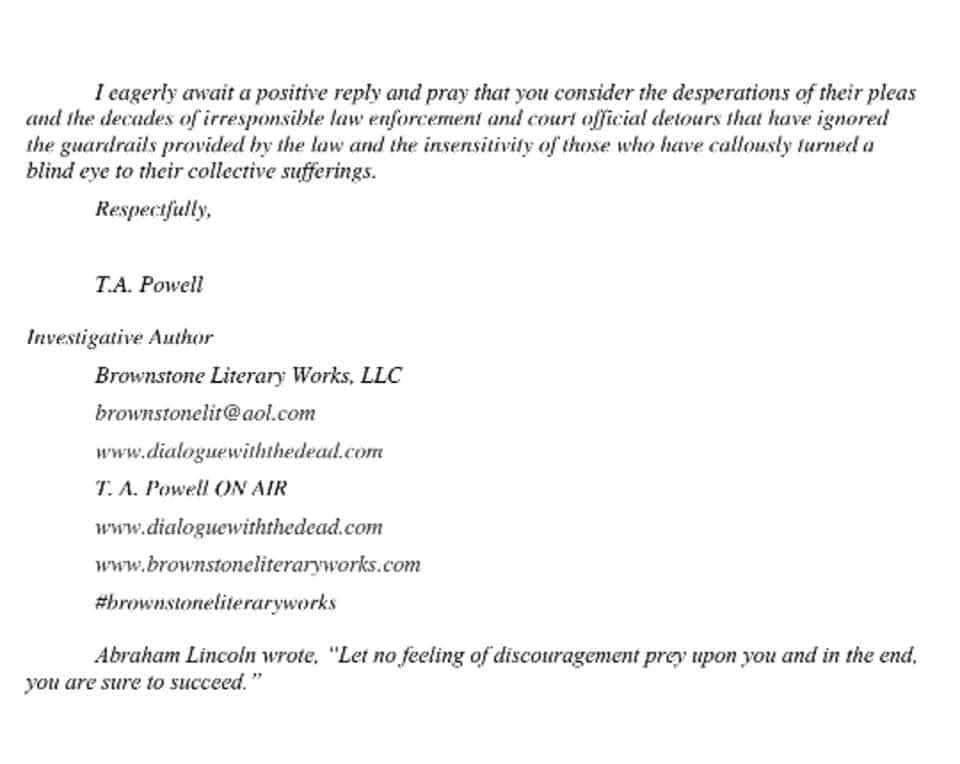
T.A. Powell letter — Page 2 of 3
"Georgia Head is being held against her will at the Ruleville Nursing Home and Research Center... under the conservatorship of a man named Ralph Price..."
You swallow. The next line is worse.
"...subjected to sexual torture, mental and physical abuse such as electrocution, and shock therapy in attempts to keep her from sharing her vital information."
The Clerk takes her glasses off. Puts them on the table. Doesn't put them back on. Your hands are shaking now. You keep reading because the Contractor told you to and because someone has to say these words out loud in this room.
"Georgia Head has been placed on the FBI Terrorist Watch List... because of her association with members of this criminal organization."
You stop. You look at the Advocate.
"A trafficking victim. A witness. Put on a terrorist watch list. Electrocuted. To keep her from talking about what happened on that Strip."
"Is that documented enough for you, Advocate? Is that a credible enough source? The FBI?"
Nothing. The Advocate is looking at the table.
"Specific members of law enforcement of concern... Agent Shelby Smith, MBI... former Chief of Police Steve Patterson of Biloxi... former Chief of Police Tommy Moffitt, Biloxi."
"She's telling the Governor that local law enforcement can't be trusted with this. That the corruption runs through the departments. Powell named them. In writing. To the state."
"This writer is formally requesting that these cases be processed under the RICO Act and presented to the Grand Jury."
You look up. The Contractor is watching you. The whole room is watching you.
"Last page."
You turn it over. Your voice is hoarse now but you don't stop. The Advocate hasn't moved.
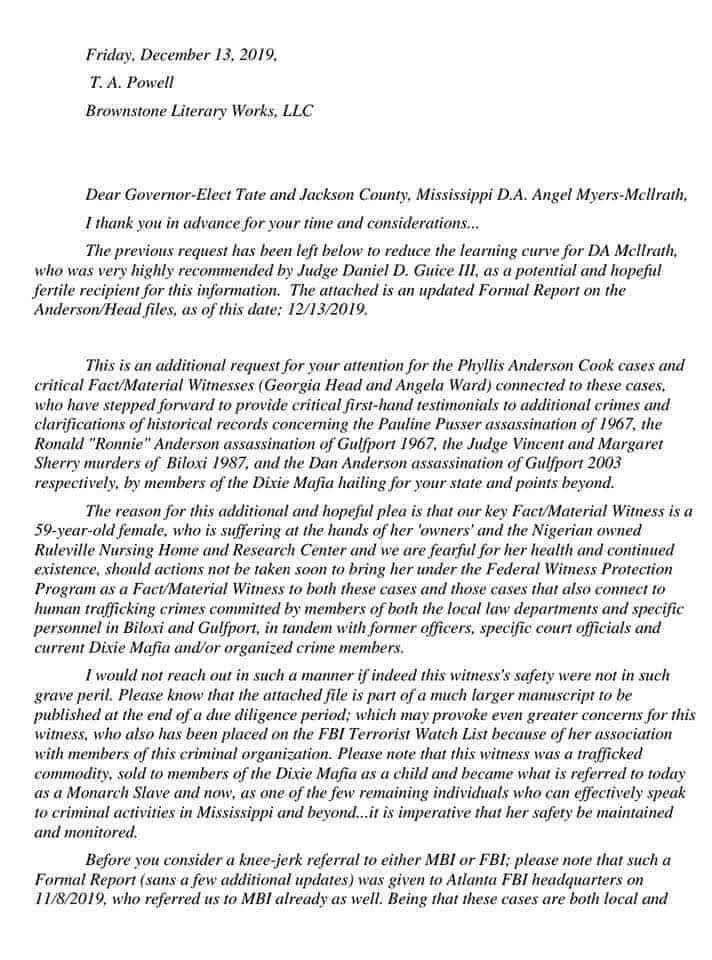
T.A. Powell letter — Page 3 of 3 — Signed, Brownstone Literary Works, LLC
"Signed... T.A. Powell. Investigative Author. Brownstone Literary Works, LLC."
You set the pages down. Three pages. Face up. In the center of the table where every person in this room can see them. Your hands are still shaking. You don't hide it.
"Real person. Real letterhead. Real ask — she requested RICO Act processing and a Grand Jury."
"And this letter was recommended by Judge Daniel D. Guice III. A sitting judge told her where to send it. A sitting judge looked at this evidence and said — go to the Governor."
. . .
Badass and Good Looking leans across the table. Not toward you. Toward the Advocate. Close enough that the Advocate leans back in the chair.
"You asked me for documents."
Points at the three pages on the table.
"There are your fucking documents."
"You asked me for corroboration. There is your corroboration."
"You asked me who Angela Ward is. She is a named witness in a letter addressed to the Governor of Mississippi and a sitting district attorney, filed with the FBI, recommended by a federal judge, requesting RICO prosecution."
"You asked where's the second witness. Her mother is the second witness — and they electrocuted her to shut her up."
"We didn't find Angela Ward in a comment section, Advocate. She was corroborated — independently — by an investigative author who went to the FBI, a federal judge, and the Governor of Mississippi. Before we ever spoke to her."
"So don't you ever sit in that chair and tell me she's not credible."
. . .
The room is vibrating. Not with sound — with pressure. The kind that builds behind your ears before a storm breaks. Nobody moves. Nobody breathes. The three pages sit in the center of the table like an indictment.
The Advocate looks at the letter. Then at the Contractor. Then at the table. Then at you — the person who read it out loud. The person whose voice cracked on the word "child." A long breath. The longest of the night.
"...I withdraw the objection."
First time tonight.
. . .
"And here's what else Angela told us. Details we didn't expect."
"FoFo used to run the Le Bistro. It was walking distance from the Lady Horseshoe — and connected via backdoors. You could walk from one to the other without stepping outside."
"This is verified."
"That FoFo ran Le Bistro — verified. That it was the gay club of Mike Gillich's portfolio — verified. The Horseshoe was the straight club. The Dream Room was the strip club. Le Bistro was the gay club. And FoFo ran it."
. . .
"There are accounts — from Angela, from others who worked the Strip — of FoFo being what they called 'flamboyant.' Overly friendly with the trans workers. The word they used was 'shemales' — their word, not ours."
"We asked Angela for proof. She sent us a photograph. FoFo — and what appears to be a transvestite. Right there in the picture."
"But Angela went further. Her personal opinion — based on years of working the Strip, seeing who came and went, who stayed late, who left together — is that FoFo was potentially involved in relationships with the shemales. Not just friendly. Not just photographed. Involved."
"That is Angela's personal observation and opinion. A woman who worked those clubs for years, who watched every Gillich who walked through that door. Her words."
The Advocate leans forward:
"How is that relevant to this discussion? We're talking about a pipeline — a political pipeline. What does someone's personal life have to do with —"
"Look at the pattern, Advocate."
"They all partake in the product they sell. Every single one."
The room shifts. The Clerk looks up from the notebook. The Mapper stops mid-connection on the board.
"And then the inquiry led us somewhere we didn't plan to go."
"According to Angela and others who worked the Strip — Mike Gillich — the uncle — and his son, Mike III, would have sex with the workers. Regularly. That was known. That was how it worked on the Strip."
"Mike III went further. According to these accounts, he would film them. And blackmail them."
The Advocate's chair creaks. Nobody says a word.
"But FoFo? Angela said he never mingled with any of the girls. Ever. Not once."
"Every other male employee did. The uncle did. The cousin did. The managers did. FoFo — never."
"The man who ran the gay club. Who was called 'flamboyant' by the people who worked there. Who was photographed with trans individuals. Who never once touched the female workers."
"Draw your own conclusions, Dear Reader."
. . .
The Advocate, voice strained:
"You understand you can't prove any of this. These are observations. Witness opinions. Speculation about someone's sexuality based on —"
"We agree."
"...you agree?"
"We can't prove it. And we are not trying to."
"That's not the point, Advocate. And you know it."
"These are observations. Witness accounts and opinions. This is as far as we can go, and we know exactly where the line is."
"But inference matters. Context matters. Circumstantial evidence matters. Every prosecutor in the country builds cases on circumstantial evidence — because patterns don't lie. People lie. Documents lie. But patterns? Patterns just are."
"We're not here to prove what FoFo did in private. We're here to show what the pattern looks like when you lay every piece on the table. And the pattern is screaming."
"So no — we can't prove it. But we don't need to. The reader can see the shape. The reader can draw the line. That's what journalism does — it puts the pieces in front of you and trusts you to see what's there."
"And the context is legal."
"Let me be precise about what we are doing — and what we are not doing."
"We are not accusing FoFo Gilich of being gay or bisexual. We make no accusation about his personal life. What we are reporting is witness speculation — accounts from multiple individuals who worked in and around the Strip clubs during that era, who have independently described the same observations. Their speculation. Their words. Not ours."
"That is an allegation based on witness accounts. Not an accusation. The distinction matters."
. . .
"Now — why it's legally relevant."
"The Dixie Mafia ran an extortion scam — the Lonely Hearts scheme — that specifically targeted gay men. Run from Angola Prison by Kirksey McCord Nix Jr. Nix placed ads in lonely hearts columns. Posed as a woman. Targeted men — especially closeted men — who were vulnerable to exposure. Then blackmailed them. Extorted them. Bled them dry. If they stopped paying, the consequences were real. Fatal, sometimes."
"That scam was funneled through Pete Halat and Mike Gillich. FoFo's uncle. The same uncle whose clubs FoFo worked at. The same infrastructure the scheme operated through."
"The connection."
"If the witness speculation is correct — and we stress, it is speculation, not established fact — then consider what that means."
"A man who allegedly understood that world from the inside — who allegedly was part of that community — ran the gay club in his uncle's portfolio. He wasn't just an employee. He was the operator. He knew the clientele. He knew the culture. He knew who was closeted, who was vulnerable, who had something to lose."
"The Lonely Hearts scheme needed exactly that kind of access."
"Did FoFo help identify targets? Did his position at Le Bistro give the scheme a pipeline to vulnerable men? Did he facilitate introductions, pass along names, provide the kind of intelligence that Nix — locked inside Angola Prison — could never have gathered on his own?"
"We don't know. We may never know. These are questions, not accusations. But we know the scam existed. We know it needed access to gay men. We know FoFo ran the establishment that provided that access. And we know the money flowed through his uncle."
"But it's worse than access. It's infrastructure."
"A Pulitzer Prize-winning author documented what FoFo actually did for the scheme. Edward Humes. Mississippi Mud. Page 166."
Badass and Good Looking reaches into the folder. Pulls out a photocopied page. The binding is cracked at that exact spot — this page has been opened a hundred times. Sets it on the table.
You lean forward. Your finger traces the highlighted line:
FROM THE RECORD
"In time, Nix eliminated the need for an accomplice to assist in patching through three-ways by buying personal computers with custom-made voice-mail and telephone switching programs—crafted by Mike Gillich's computer-expert nephew, Andrew Gilich."
— Edward Humes, Mississippi Mud (1994), p. 166
Pulitzer Prize-winning author
"FoFo didn't just know the clientele. He didn't just run the club. He built the computer systems that let Nix run the Lonely Hearts scam from inside Angola Prison."
"Nix would call from prison — supposedly to his lawyer, Pete Halat. Attorney-client privilege. Nobody monitors those calls. But Halat's office had FoFo's computer system. The computer three-wayed the call to the next victim. The call was tunneled through attorney-client privilege."
"FoFo wasn't a bystander, Advocate. He was the engineer."
. . .
"And according to Angela — it didn't stop at phone systems."
"Angela reported that online sales of pornography were a significant part of the organization's revenue. Not a side operation. A business line. The Strip didn't just sell bodies in rooms — it sold them online."
"She provided a video — with cached web records — showing Gillich-linked names in online porn distribution. Real cached data. Real names."
The Mapper turns from the board. The string in his hand — the gold one — is taut.
"From strip clubs to phone scams to online porn. Three decades. Three platforms. Same family. Same product."
"The computer-expert nephew built phone-switching systems for a prison extortion ring in the 1980s. According to Angela, the family's operation evolved — from three-way calling to online content distribution. The technology changed. The business model didn't."
. . .
"And the federal government noticed. November 1990 — your future mayor walked out of a federal grand jury. The same grand jury investigating the Sherry murders. The same scam he built the computer systems for."
"Access. Infrastructure. Online distribution. And a federal grand jury subpoena. That's the Lonely Hearts connection."
. . .
The Advocate speaks carefully.
"You realize what you're doing. You're publishing speculation about a sitting mayor's sexuality. Even framed as witness accounts — that's a defamation lawsuit waiting to happen."
"No. It isn't. And here's why."
"First — we accuse nothing. We report what witnesses have speculated. Their observations, in their words, clearly attributed. That's protected reporting under the First Amendment."
"Second — FoFo Gilich is a public official. A four-term mayor. Under New York Times v. Sullivan, public officials must prove actual malice — knowledge of falsity or reckless disregard. We have neither. We have good-faith reporting of witness accounts."
"Third — and this is the one that matters most — a documented federal criminal enterprise specifically targeted gay men for extortion and blackmail. That enterprise was run through this man's uncle's clubs. This man worked at those clubs. The question of whether this man fell within the target demographic of that scheme is not gossip — it is a matter of legitimate public concern. It goes directly to whether a sitting mayor may have been compromised by a criminal enterprise that his own family operated."
"That's the legal angle. That's why we can print it. And that's why we must print it."
"We're not outing anyone. We're documenting a criminal pattern that makes the question relevant. The Lonely Hearts scheme needed operators on the ground — people who could identify targets, build trust, and provide access. Someone who understood the community. Someone who was the community."
"Maybe FoFo wasn't compromised. Maybe he was one of them. Maybe he learned the family business not by being a victim of the scheme — but by helping run it."
"We allege nothing as fact. We speculate based on documented patterns and witness accounts. And a documented criminal enterprise that needed exactly the kind of access FoFo had. That's the connection. And that's the defense."
* the Advocate doesn't answer. but the objection is gone from the face. what's left is something closer to understanding. *
. . .
Badass and Good Looking turns to the Advocate.
"You want to dispute credibility? Dispute the book. Dispute the name. Dispute the photographs. Go ahead."
. . .
The Advocate stands up.
"One witness. One person's memory from decades ago. That's what you're building this on?"
"She has photographs."
"Photographs prove she was there. They don't prove who delivered what to whom in a parking lot thirty years ago."
"She was seven. Children don't fabricate parking lot drug deliveries. They remember faces. And she remembered his."
"Memory is unreliable. You know that. Every defense attorney in this country knows that. A seven-year-old's recollection of —"
Badass and Good Looking slams a hand on the table. The coffee cups rattle. The folder slides.
"We asked her on a Monday. We asked her again on a Tuesday. Different questions. Different order. Same answers. Same parking lots. Same face. Same complaint — don't bring the girl."
"Her mother was a prostitute on that Strip. Angela became a prostitute on that Strip. She has photographs from inside the Dream Room taken by the staff. And you want to talk about memory?"
The Advocate's voice is louder now.
"I'm saying one witness — no matter how sympathetic — doesn't prove the current mayor ran drugs in the 1990s. You need corroboration. You need —"
"Powell's book."
"A book isn't a court filing —"
"The Insider."
"Anonymous —"
"The photographs."
"Photographs of her, not of —"
"The arrest records. The conviction records. The employment records. The family tree. The BZA minutes. The corkboard behind you with every string leading to the same name."
* silence *
"You want corroboration, Advocate? Turn around. It's on the wall."
The Advocate doesn't turn around. Doesn't sit down. Just stands there — one hand on the table, one hand at their side. The air in the room tastes like metal.
Quieter now. Almost a whisper.
"I'm not disputing what happened to her. I'm disputing what you're building with it."
"I'm not building anything. I'm pointing at what's already there."
. . .
"The Insider grew up on that Strip. Watched it happen. Angela Ward was seventeen. Her mother was fourteen. Different decades. Different voices. Same Strip. Same family. Same machine."
"That's not one person's story, Advocate. That's a system."
. . .
The Advocate is on their feet now. Face flushed. Voice shaking.
"You can't accuse a sitting mayor of being a past drug dealer. Are you out of your mind?"
"Take a look at yourself. You're in a room with a deadbolt and a corkboard and you think you can publish allegations like this? Against the mayor of Biloxi? With witness testimony and parking lot memories and a book nobody's read?"
"You'll get sued. You'll get destroyed. You'll lose everything."
The room holds its breath. The Clerk's pen is frozen mid-word. The Mapper's hand is still on the board.
Badass and Good Looking doesn't flinch. Reaches into a folder. Pulls out a single printed page. Slides it across the table — past you. Your eyes catch the letterhead. The CC line. The names. Six of them. You see them for half a second before the page passes. It's enough.
The page lands in front of the Advocate.
"Read it."
The Advocate looks down. Reads.
. . .
Email — Sent January 26, 2026, 8:06 AM
To: Mayor Gilich (mayor@biloxi.ms.us)
CC: Michael Whitehead, Richard Weaver (CAO), Zachary Cruthirds, Joseph H. Ros, Peter Abide, Catherine McMahan
Subject: People vs Biloxi Publication
Mayor Gilich:
People vs Biloxi is preparing an article concerning your involvement with Le Bistro, the establishment connected to the Horseshoe on Biloxi's Strip, and your role in Gillich family operations during that period.
We have spoken with individuals who worked in these establishments (Le Bistro, Horseshoe, Dream Room) and have provided detailed accounts.
The topics to be addressed may include:
• Your speculated homosexuality by said witnesses and its relevance to documented Dixie Mafia extortion patterns targeting gay men
• Allegations that you dealt and supplied drugs to clubs, clients, and dancers
• Allegations concerning pornography-related distribution
• Prostitution involvement and detailed accounts by your cousin Michael III
We are offering you the opportunity to respond before publication.
If you wish to provide a statement, please respond by 2:00 PM today. Absent a response, the article will be published without your comment, and this correspondence will be referenced as having had the opportunity to respond.
Yuri Petrini
People vs Biloxi
peoplevsbiloxi.com
The Advocate stares at the page. Reads it again. Looks at the CC line. Counts the names.
"Michael Whitehead — the mayor's personal attorney. Richard Weaver — the Chief Administrative Officer. Zachary Cruthirds and Joseph Ros — Currie Johnson, the city's outside law firm. Peter Abide — Director of Legal Affairs. Catherine McMahan — the mayor's office."
"Six people. Plus the mayor. Seven recipients. Sent yesterday morning at 8:06 AM."
. . .
"We gave him until 2:00 PM to respond. To refute. To deny. To explain. To say anything."
"He didn't."
* silence *
"None of them did."
"Count them. Four attorneys. The CAO. The mayor himself. Two mayor's office staff."
"Pure silence."
. . .
"So when you say I can't accuse a sitting mayor, Advocate —"
"I didn't accuse him. I gave him the floor. He chose silence. Seven people saw that email. And seven people said nothing."
* the Advocate slams the table *
"FUCK."
The coffee cups jump. A folder slides off the edge. The Clerk catches it. The Mapper doesn't flinch. You do.
The Advocate stands there — breathing hard, both fists on the table, staring at the printed email like it just ended the argument for good. Because it did. Not because the evidence was overwhelming. Because the process was airtight. The mayor had the floor. His attorneys had the floor. And every single one of them chose silence.
The Advocate sits down. Slowly. Doesn't look at anyone.
. . .
Ten seconds pass. Fifteen. The Advocate breathes. Straightens in the chair. And speaks again — quieter, but not broken. Not yet.
"I understand you need to be cold about this. I do. I understand the process. But —"
"But what?"
"But you're connecting dots that don't necessarily —"
Badass and Good Looking stands again. The chair scrapes back. The voice isn't raised — it's loaded.
"Look at the fucking facts."
"The uncle — Mike Gillich Jr. — convicted of murder conspiracy. Prostitution entrepreneur. Court record. Federal conviction. Twenty years."
"His son — Michael III — convicted of child sexual abuse. Court record. Twelve years. Confirmed by court, by public record, by witnesses."
"Cliff Kirkland — convicted pedophile. Nine counts. Thirty-five years. Hired by FoFo."
"Pete Halat — the man hugging FoFo from behind in that photograph — convicted. Eighteen years federal. Murder conspiracy."
. . .
"And FoFo? FoFo ran the clubs. The infrastructure. The Lonely Hearts scheme was run from prison — by Nix, through Halat, through Mike Gillich. The man hugging him from behind and his own uncle. FoFo worked at the clubs that were part of it."
"Did he really not know?"
The question echoes. The Mapper's hand freezes on the string.
"How can you be the programmer and not know how the program is being used? How can you build the machine and not know what it does?"
"That's not —"
"This isn't 2026 where you grab a phone and dial. This was the eighties and nineties. Things had to be set up. Physically. Deliberately. Rooms had to be wired. Cameras had to be placed. Clients had to be identified, targeted, recorded, and then extorted."
"That's not something you stumble into. That's not something that runs itself. Someone had to build it. Someone had to maintain it. Someone had to know every name on every tape."
"He had to be deeply involved for it to even work. There is no version of this where the man who ran the infrastructure didn't know what it was being used for."
. . .
The Advocate opens their mouth. Nothing comes out. They close it. Open it again.
"...I don't have a response to that."
* longest silence of this section *
. . .
Badass and Good Looking reaches for something else. A newspaper clipping. Yellowed. Creased at the fold. Places it in the center of the table. You lean forward — the paper smells old. Newsprint ink. Thirty-six years old. Your finger touches the edge. The paper is brittle. You pull back before it tears.
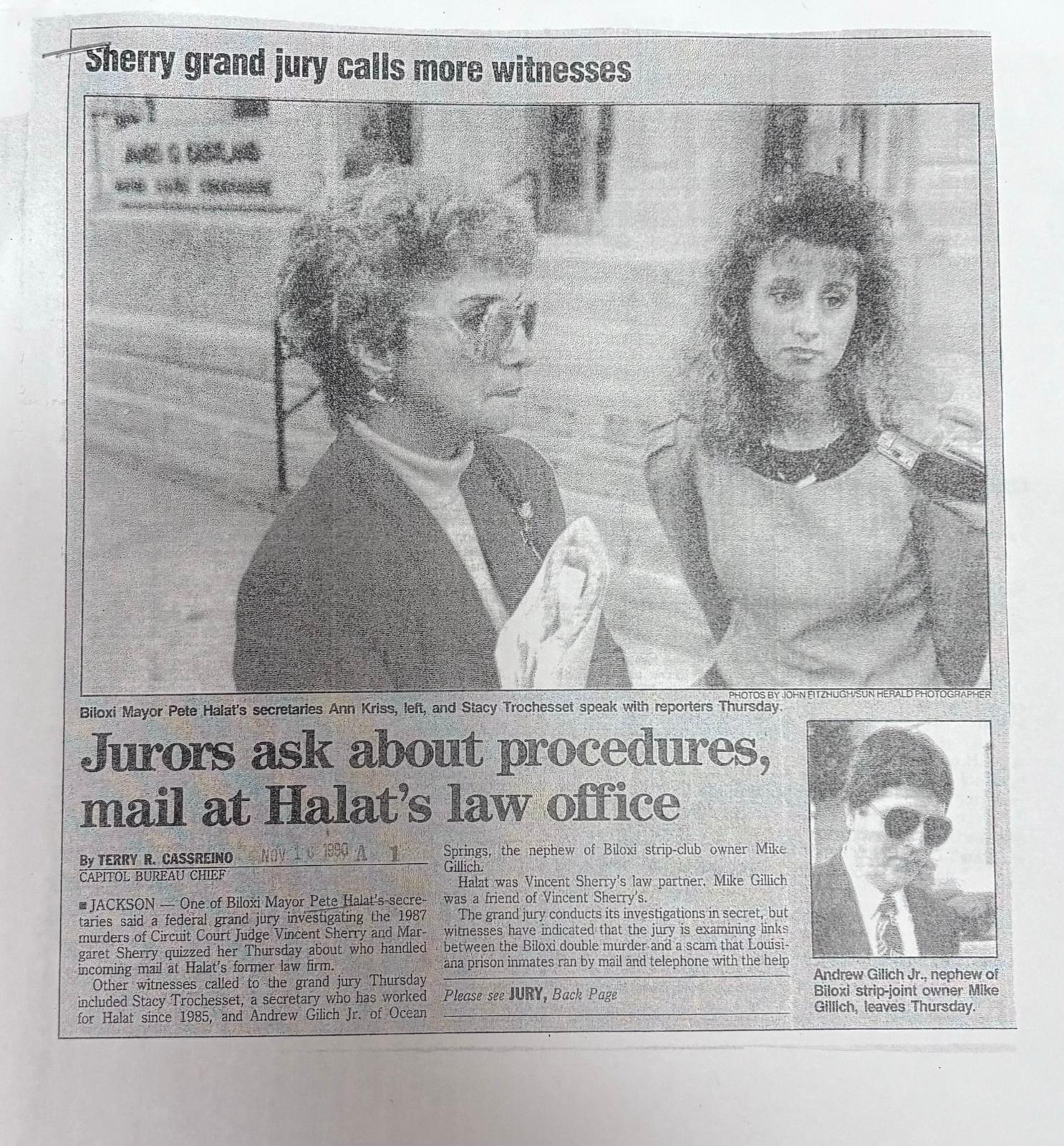
"Andrew Gillich Jr., nephew of Biloxi strip-joint owner Mike Gillich, leaves Thursday."
— November 1990, Federal Grand Jury
"FoFo was brought before a federal grand jury. He's in the newspaper. They called him in to talk about it."
"The grand jury investigating the Sherry murders. The same murders triggered by the Lonely Hearts scam. The same scam run through his uncle's infrastructure. The same clubs FoFo worked at."
"He was questioned about it. Under oath. In front of a grand jury. This isn't us digging — this is the federal government digging. And they pulled him in."
. . .
"And you'd think — after all of that — after the grand jury, after the convictions, after Halat served eighteen years for conspiracy to murder a judge and his wife —"
"You'd think FoFo would stay away from him."
. . .
"He didn't."
"We posted on Facebook. Asked the public. And the responses poured in."
"Several witnesses — unrelated to each other, from different walks of life — reported seeing FoFo and Pete Halat together. In public. At restaurants across the Coast."
"Different people. Different locations. Different days. All saying the same thing — they still meet."
"One server said every Wednesday. A regular. Same table. Same two men. Weekly."
The Advocate's head snaps up.
"People have lunch. That doesn't mean —"
"The man was convicted of murder conspiracy, Advocate. Eighteen years federal. He conspired with FoFo's uncle to kill a judge and his wife. And FoFo meets him for lunch. Every. Wednesday."
"Old relationships don't automatically imply —"
"Are they all fabricating? The server? The people at the next table? The citizens who responded — people who don't know each other, from different parts of the Coast, different professions, different ages — all independently saying the same thing?"
"What are they, if not friends? If not more?"
* the Advocate shifts in the chair — doesn't interrupt *
"After everything. After the Sherry murders. After the Lonely Hearts scam. After the trial. After the conviction. After eighteen years in federal prison —"
"They still meet. Weekly. In public. Like nothing happened."
. . .
"The fucking guy was convicted for murder, Advocate. And he was involved with FoFo's uncle. They conspired together. Halat handled the money. Gillich arranged the hit. Both convicted."
"And the nephew — the mayor — still sits across from him at a restaurant every Wednesday like they're catching up on old times."
"You want to talk about decades ago? Fine. We've been doing that all night."
"This happens now. This is not 1990. This is not 1997. This is 2026. After everything — after the murders, after the convictions, after the grand jury, after all of this —"
"They still sit down together. Weekly. Right now. While he's your mayor."
The Advocate doesn't move. Doesn't speak. The Clerk has stopped writing. The Mapper's hand is flat on the table. The Insider is staring at the wall.
"So you tell me, Advocate. You tell them —"
"What are two men who share a murder conspiracy, a grand jury investigation, a family name, and a weekly dinner — what are they?"
* silence *
. . .
Badass and Good Looking looks at you. Not the room. You.
"One more thing, Dear Reader. And this is important."
"We can't prove he did it. We won't pretend we can. We are not making it more than what it is."
"But she worked there. She saw it. She remembers. Her accounts are detailed, consistent, and corroborated by records we had to dig to find."
"This goes as far as it can go in terms of what can be shown. And what can be shown is enough to ask the question."
"We asked it. To his face. In writing. With his attorneys copied. And the answer was silence."
* the Insider still hasn't looked up. but a hand is trembling on the table. *
Agenda Item V — The Double Standard
Badass and Good Looking stands. Doesn't go to the board this time. Walks to the window. Pulls the blind aside. Looks out at the parking lot. Then turns back.
"Now let me tell you what almost happened."
"Star Lounge was approved. May 2018. The Board of Zoning Adjustments said yes. Case 18-020. A strip club. On the Strip. For Michael Gillich III — the son of the Dixie Mafia kingpin."
"While his cousin — FoFo Gilich — was sitting in the Mayor's office."
"If Mike 3 had not been arrested in December 2019 — if the meth and the fraud hadn't caught up to him — that club would have opened."
"Think about that. A Gillich — the son of the man who arranged the Sherry murders — running a strip club on the same Strip his father ran. In 2019. While the nephew of the same man is the Mayor of Biloxi."
"The city approved it."
. . .
"The BZA approved a zoning application. That's their function. They review applications against criteria — "
"Let me tell you about criteria, Advocate."
"We filed for a permit at 929 Division Street. A deck. A residential structure. Not a strip club. Not a bar. A deck."
"The City of Biloxi demanded three separate engineering reports. Three. From three different firms. To approve a residential deck."
"They denied our permit for seventeen months. They made us hire engineer after engineer. They found objection after objection. Every inspection was a new problem. Every submission was incomplete."
"But a strip club — for the Dixie Mafia kingpin's son? That sailed through."
. . .
"Different applications. Different standards. Zoning and building permits are separate processes — "
"They're separate departments in the same city government. Under the same mayor. FoFo's cousin gets a strip club approved on the Strip. We get three engineering reports demanded for a deck on Division Street."
"You tell me what the criteria are, Advocate. Because from where I'm sitting, the criteria is your last name."
Your hand tightens around the pen. The plastic casing creaks. You look at the BZA minutes face-down on the table — Case 18-020, approved — and then at the family tree in your lap. The same last name on both documents. You flip the BZA page over. Read the applicant's name one more time. Set it face-down again. Some things you only need to read once.
. . .
"And don't tell me FoFo didn't know. Don't tell me the Mayor of Biloxi didn't know his own cousin was opening a strip club on the Strip that his uncle built."
"FoFo is far from innocent."
"He ran the gay club. He was called before a federal grand jury. He hired the convicted conspirator's right-hand man. His cousin got a strip club approved under his watch. And he meets with Pete Halat — the man convicted for the Sherry murders — every week."
"Far. From. Innocent."
. . .
The Advocate stares at the table. Hands flat. Not performing. Not objecting. Just — sitting there.
"I can't make an argument against this."
. . .
The voice is different now. Quieter. Almost pleading.
"I'm not saying you're wrong. I'm saying — do you understand what you're doing? Do you understand the consequences of putting this in front of people?"
"You're accusing a sitting mayor's administration of approving a strip club for the Dixie Mafia while blocking a resident's deck for seventeen months. You're naming the family. You're naming the cousin. You're naming the dead uncle and the living nephew and the zoning case number."
"This is an uphill battle. It's just — it's too much. The city has attorneys. The mayor has attorneys. They will come for you. They will bury you in motions. They will exhaust you. They will make you wish you never looked at that zoning file."
The Advocate's hands are shaking.
"Think about what you're walking into."
. . .
The room is still. The Clerk's pen hasn't moved. The Mapper is watching the Advocate — not with disagreement, but with something worse. Recognition.
Badass and Good Looking doesn't flinch. Doesn't raise the voice. Doesn't slam the table.
"Exactly."
"It's an uphill battle. It's too much. The city has attorneys. The mayor has attorneys. They will come for us. They will bury us in motions. They will exhaust us."
"And that's exactly why we have to do it."
. . .
"Because if we won't — who will? Who else is sitting in a room with a deadbolt and a corkboard, matching zoning files to bloodlines? Who else has Angela's photographs and the Insider's memory and the Mapper's board and the Clerk's folder?"
"Nobody."
"So yes, Advocate. It's an uphill battle. It's always been uphill. Since 1987. Since the Golden Nugget. Since the Sherry murders. This has always been uphill."
"And we're still climbing."
* the Advocate looks down. doesn't respond. but the shaking has stopped. *
Agenda Item VI — The Sentences
THE MAPPER
The Mapper stands. Walks to the board. Writes two numbers.
BADASS AND GOOD LOOKING
"Cliff Kirkland. May 2022. Convicted on all nine counts of child molestation. Thirty-five years."
"Michael Gillich III. August 2025. Convicted of child sexual abuse. Twelve years."
. . .
The Mapper writes the sum on the board.
47 YEARS
You write it down. The pen presses hard enough to dent the paper. 47. You underline it. Twice.
"Forty-seven years of prison time. Both convicted of crimes against children. Both from the same orbit."
"Kirkland — FoFo's direct hire. Convicted. Thirty-five years. Appeal denied October 2023. Currently incarcerated."
"Michael III — FoFo's first cousin. Convicted. Twelve years. Currently incarcerated."
. . .
"Kirkland's charges expanded from two counts to nine. Nine counts of gratification of lust involving a child. Harrison County Circuit Court. The Mississippi Court of Appeals reviewed the case in October 2023 and denied the appeal."
"This wasn't an accident. This wasn't a one-time mistake. Nine counts means a pattern. A pattern that was happening while he held a title in FoFo's administration."
"Chief Innovation Officer. That was his title. From 2015 until his arrest in December 2019."
"Four years. Four years inside City Hall. Hired by the nephew of the Dixie Mafia kingpin. Previously employed by the co-conspirator who triggered the Sherry murders."
A different voice from the dark corner. Quieter. More careful.
"I never saw anything. I want to be clear about that. But the fact that nobody checked — that nobody asked who this man was before they gave him a title and a city email — that tells you everything."
. . .
"One more thing on Kirkland."
Badass and Good Looking turns to the Insider.
"When Cliff Kirkland was arrested for child molestation in December 2019 — what did the Mayor say?"
. . .
"Nothing."
"No press conference. No internal email. No staff meeting. No statement to media."
"The Chief Innovation Officer of the City of Biloxi was arrested for molesting children. And the Mayor's office said nothing."
"The Mayor of Biloxi's direct hire — the man he brought into City Hall, the man who had a city email and a city title for four years — was arrested for nine counts of child molestation."
"And FoFo Gilich said nothing."
"Not then. Not at the trial. Not at the conviction. Not at sentencing. Not when the appeal was denied."
"Silence, Dear Reader. That's the mayor's official position on his hire molesting children. Silence."
. . .
The Advocate tries. The voice is thinner now.
"You're adding prison sentences together. That's arithmetic, not analysis. Two separate cases. Two separate courts. Different charges. Different years. The only thing connecting them is proximity to the same elected official."
"And proximity isn't proof."
BADASS AND GOOD LOOKING
Badass and Good Looking stands. Walks to the Advocate's end of the table. Puts both hands flat on the wood.
"You're right. Proximity isn't proof. We never said it was."
"But forty-seven combined years of prison time. Both for crimes against children. Both men from the same mayor's orbit — one by blood, one by paycheck. Both arrested the same week in December 2019. Both convicted."
"We're not arguing causation. We are documenting a pattern so dense that the only way to ignore it is to close your eyes."
"Are your eyes closed, Advocate?"
* silence *
Agenda Item VII — The Pipeline
Badass and Good Looking sits back down. The coffee is cold. Nobody has touched it in an hour. The energy in the room has changed — it's heavier now. Compressed. Like the air before a verdict. This isn't the introduction anymore. This is the summation.
"Mapper. Put it all on the board."
. . .
THE MAPPER
The Mapper draws a single vertical line on the board. He writes dates next to it.
"1987. Mike Gillich Jr. and Pete Halat conspire to murder Judge Vincent Sherry and his wife Margaret. Gillich arranges the hit. Halat triggers it."
"1989. Pete Halat becomes Mayor of Biloxi. While the FBI investigates him for murder. He hires Cliff Kirkland. Makes him Director of Marketing. Then promotes him to CAO — the highest non-elected job in the city."
"1991. Mike Gillich Jr. convicted. Twenty years."
"1997. Pete Halat convicted. Eighteen years."
"2012. Mike Gillich Jr. dies. Cancer. Age 82."
This is where a normal timeline ends. It didn't.
"2013. Michael Gillich III — Mike Jr.'s son — forms Star Lounge LLC. Trying to open a club on the Strip. The same Strip his father ran."
"2015. FoFo Gilich — Mike Jr.'s nephew — becomes Mayor. Hires Cliff Kirkland as Chief Innovation Officer. The same Cliff Kirkland who served under Pete Halat."
"May 2018. Michael III's Star Lounge approved by the Board of Zoning Adjustments. Case 18-020. 176 Veterans Avenue."
"December 13, 2019. Michael Gillich III arrested. Fraud. Meth."
"December 17, 2019. Cliff Kirkland arrested. Child molestation."
"May 2022. Kirkland convicted. Thirty-five years."
"August 2025. Michael III convicted. Twelve years."
. . .
The Mapper steps back from the board.
"That's the pipeline. 1987 to 2025. Thirty-eight years. The same names. The same families. The same street."
"Halat hired Kirkland. Halat conspired with Mike Gillich Jr. FoFo — Mike Jr.'s nephew — hired the same Kirkland. Mike Jr.'s son tried to reopen the Strip. Both Kirkland and the son were arrested the same week. Both convicted of crimes against children."
"It's the same thread. Thirty-eight years. And it never snapped."
. . .
The Mapper reaches into the folder one more time. Pulls out a photograph. Pins it to the board — at the very top. Above everything.

FoFo Gilich with former President Bill Clinton
"And the pipeline doesn't stop at City Hall."
"The nephew of a convicted Dixie Mafia kingpin. The man who built the computer systems for a prison extortion ring. The mayor who hired a child molester. Standing shoulder to shoulder with a former President of the United States."
"And not just any president. A president who has himself faced accusations of sexual misconduct. A president whose name appeared on the flight logs to Jeffrey Epstein's island — the same Epstein convicted of sex trafficking minors."
"Birds of a feather, Dear Reader."
"We are not accusing Clinton of anything. We are not accusing FoFo of anything because of this photo. What we are showing you is who has access to whom. What circles these people move in. What company they keep."
"A man whose uncle ran strip clubs and prostitution rings. Whose family trafficked a fourteen-year-old girl. Whose cousin filmed and blackmailed sex workers. Whose hire molested children. Standing next to a man whose name is on Epstein's flight logs."
"That's not an accusation. That's a photograph. And photographs don't lie."
. . .
The room is quiet. The coffee is cold. The dark corner hasn't moved.
Badass and Good Looking looks at you.
"That's what we found, Dear Reader."
"Stand up, Dear Reader."
You stand. The chair scrapes. The room watches.
"Walk to the board. Look at it. Trace the string."
You walk to the corkboard. Up close, it's worse than it looked from the table. Photos. Names in marker. Dates circled in red. And the string — red, gold, black — running from one pin to the next. The pins are cold under your fingertip. You put your finger on Mike Gillich Jr. and trace the line. The string hums when you brush it — tight, like a guitar string tuned too high. It goes to Halat, to Kirkland, to FoFo, to Michael III. Your finger runs out of string before the board runs out of names.
"A pipeline. From 1987 to today. From the Golden Nugget to City Hall. From murder conspiracy to child molestation. From the Dixie Mafia kingpin to his nephew's administration."
"Sit down."
You sit. The pen is still in your hand. The notepad has the number 47 underlined twice.
Count it. The arrest reports are on the Advocate's side of the table. The family tree is in your lap. The BZA minutes are face-down. The photo is back in the folder.
And you know things now that you can't unknow.
"We didn't guess. The Clerk sourced every fact. The Mapper drew every line. The Insider confirmed what they could."
. . .
"And now let's talk about the man at the top of this pipeline. The one who's still in office. Still signing checks. Still running this city."
"FoFo Gilich can't even get a carpet right."
"Seventy-three thousand dollars. One carpet. For the Saenger Theatre. His administration approved it over the contractor's own objections. The contractor told them it wouldn't work. They installed it anyway. It doesn't match. Now it needs another seventy thousand to fix."
"Eight years. Five million dollars. The theater is still dark. And the carpet doesn't match the room."
"That's who's running this city. A man who can't install flooring."
. . .
The Advocate sits up. This one, the Advocate wants.
"Incompetence isn't corruption. A mismatched carpet isn't a RICO predicate. You're conflating bad management with criminal intent, and that's a dangerous line to cross in print."
"You're right. A carpet isn't a crime."
"But Peter Abide is."
. . .
"Peter C. Abide. Director of Legal Affairs. FoFo's right hand. The man who signs off on every enforcement action, every permit denial, every legal position the City takes. The man who controls which lawsuits get fought and which get settled. Which ordinances get enforced and which get ignored."
"When Jerry Creel denied a permit for seventeen months at 929 Division Street while approving an identical project for a Council member's mother-in-law in days — Abide's office backed it. When CenterPoint Energy operated without permits, without paying fees, without a franchise agreement — Abide's office covered it. When the Deputy Clerk fabricated a document to justify CenterPoint's non-compliance — Abide's office said nothing."
"Selective enforcement. Fabricated justifications. Self-dealing. Obstruction. All documented. All sourced. All leading back to the same office."
. . .
"You're describing a civil rights lawsuit. That's not the same as—"
"We're bringing a RICO case."
Your pen touches the notepad before you decide to write. Four letters. R-I-C-O. You circle it. Your hand is shaking — not fear, not cold. Something else. The kind of shake that comes when you hear something said out loud that you've been thinking for an hour but didn't dare write down.
. . .
The room shifts. The Clerk looks up from the folder. The Mapper turns from the board. Even the Insider moves.
"Not hypothetically. Not someday. We have documented patterns of corruption. Self-dealing. The CenterPoint fraud — a utility company operating for years without permits, without fees, protected by fabricated documents. Selective code enforcement used as a weapon against property owners who don't play ball. Permit denials designed to exhaust and bankrupt. And at the center of all of it — Peter Abide and FoFo Gilich."
"An enterprise. A pattern of racketeering activity. Exposed through three federal civil rights cases. Documented across hundreds of pages of public records, sworn testimony, and city filings."
. . .
"And then there's Jerry Creel."
"FoFo's Building Official. The man who enforces the code — or doesn't — depending on who you are and who you know."
"Creel committed four instances of felony perjury."
The Clerk opens a folder without being asked. Two pages. She slides them to you — one in each hand, left and right. Side by side.
You look down. Left page: a criminal summons. Right page: a sworn affidavit. Your eyes go to the dates. Left — July 9. Right — July 10. You read them again. You read them a third time. The summons was issued before the affidavit. The charge existed before the oath. Your finger taps the date on the left page. Then the right. July 9. July 10. The order is wrong. Your stomach knows it before your brain does.
"July 10, 2025. Four sworn criminal affidavits. Each one claiming he 'personally observed' violations at a property. Signed under oath. Notarized by his own clerk — Brooke Vanover — from the Building Department."
"One problem. The criminal summons — Case CC-51719 — was issued on July 9th. One day before the affidavit. You can't issue a summons for a crime that hasn't been sworn to yet. You can't charge someone based on observations that haven't happened."
"The prosecution preceded the evidence. The charges existed before the oath. Four counts. Felony perjury. Documented. Irrefutable."
. . .
The Advocate leans forward.
"What happened to the case?"
"Collapsed. The prosecution couldn't produce evidence to support the charges. The four sworn affidavits — the sole basis for the criminal prosecution — proved insufficient. And at the Board of Adjustments hearing, in front of eight board members, two police officers, defense counsel, and a court reporter — the plaintiff called Creel a perjurer. To his face. On the record."
"Nobody denied it."
. . .
"So let's count. Peter Abide — directing legal cover for selective enforcement. Jerry Creel — four felony perjuries, fabricated criminal charges, armed police deployments against property owners. CenterPoint — operating for years under fabricated documents, over $100,000 in unpaid permit fees. Selective code enforcement — seventeen months to deny one man's permit while approving a Council member's family in days."
"FoFo can't get a carpet right. But he and Abide and Creel have been running a machine for ten years — selectively enforcing, selectively ignoring, selectively profiting. And we have it all on paper."
. . .
The Advocate opens the mouth. Closes it. Opens it again.
"RICO requires a pattern of predicate acts. Wire fraud. Mail fraud. Extortion. Obstruction. You're alleging—"
"We're not alleging. We're documenting. And the federal court will decide what it is."
. . .
"But I'll tell you what it looks like from this table, with this board, after seven agenda items."
"The Dixie Mafia didn't end. It evolved."
"In the 1980s, they ran strip clubs and ordered murders. They operated outside the law. Gillich had the Golden Nugget. Nix had the Lonely Hearts scheme. Halat had the mayor's office — for a while."
"They got caught because they were outside the system. The FBI could see them. The federal courts could reach them."
"So the next generation didn't stay outside. They captured the city."
"FoFo Gilich — Mike Jr.'s nephew — didn't open a strip club. He became the mayor. Peter Abide didn't become a fixer. He became the Director of Legal Affairs. Jerry Creel didn't work outside the law. He became the man who enforces the law — selectively, punitively, with perjured affidavits and armed officers."
"They don't need the Golden Nugget anymore. They have City Hall. They don't need hit men. They have code enforcement officers. They don't need Halat's law practice as a front. They have the entire City Attorney's office."
"And they don't need a crooked judge on the payroll. They have Apryl Ready."
Your eyes shoot to the corkboard. You scan the names — Gillich, Halat, Kirkland, FoFo, Abide, Creel. No string for Ready. Not yet. But the Mapper is already reaching for a pin. A new pin. He pushes it into the board — bottom left, below the others. Writes two words in red marker. You can read them from where you're sitting. Your chair creaks when you lean forward to make sure.
. . .
The Advocate's head snaps up.
"A judge? You're going after a judge?"
"Municipal Court Judge. Part-time contractor. Bills $140 an hour. Her paycheck is approved by Peter Abide — the same Peter Abide we just named as a defendant in three federal civil rights cases. She issued an illegal cease and desist order at a criminal arraignment — called it a 'hearing.' Zero jurisdiction over building matters. Zero due process. Zero."
"She's dirty. Like Uncle Mike. Corrupt lawyer. Corrupt judge. Corrupt officials. The whole apparatus."
"FoFo learned the family business. He didn't learn how to run a city — he can't even get a carpet right. But he learned how to capture one. The mayor's office. The legal department. The building department. And the municipal court."
. . .
"You filed against her?"
"We just filed a state court lawsuit. Yesterday."
. . .
"But that's tomorrow's meeting."
Badass and Good Looking looks at you. At the room. At the board.
"Judge Ready gets her own agenda item. Her own board. Her own strings. Because what she did — what Abide set up — is a separate machine. And we're going to take it apart piece by piece."
"Tonight we documented the pipeline. Tomorrow we document the bench."
* the room is silent. the Insider is staring at the table. the Advocate has stopped writing entirely. *
. . .
"The Dixie Mafia didn't die. It got a city seal, a corner office, a Building Department, and a courtroom."
. . .
BADASS AND GOOD LOOKING
Badass and Good Looking turns to the far end of the table.
"Advocate."
"You've heard seven agenda items. You've challenged every one. That was your job. You did it."
"Can you break the timeline?"
. . .
THE DEVIL'S ADVOCATE
The longest silence of the night.
"I broke Item III. The timing. I'll take that. Four days apart doesn't prove coordination and you know it."
Pause. The Advocate looks at the board. Not at anyone. At the board.
"But I've been sitting here for seven items trying to break this pipeline. And I'll be honest with this room — I can break individual pieces. A nephew running for office. A career government employee getting a second chance. A business opening on a public street."
"I can explain each one away."
Long pause.
"But I cannot explain the sequence. I cannot explain why it's always the same names. I cannot explain why every string on that board leads back to the same table. I cannot explain a background memo about a Halat connection going to the Mayor's office and nothing happening. And I cannot explain forty-seven years of prison time for crimes against children — both from the same mayor's orbit — and the Mayor's silence."
"I took Item III. But I could not take the pipeline."
"I have no further objections."
* the room is completely still *
. . .
"Let the record show — the Advocate broke one item. The timing. That's fair. That's how this room works."
"But the Advocate could not break the pipeline."
The Clerk writes something in her folder. The Mapper steps back from the board. The Insider doesn't move.
. . .
The Verdict
Badass and Good Looking stands. Walks to the head of the table. Looks at each person in the room.
"Before this meeting ends — we go around the table. One statement from each of you. On the record."
"Does the pipeline hold?"
. . .
THE CLERK
The Clerk adjusts her glasses. Opens her folder one last time. Closes it.
"Every fact in this room is sourced. Every date is documented. Every name is verified. The record supports the pipeline."
. . .
THE MAPPER
The Mapper looks at the board. At the strings. At thirty-eight years drawn in three colors.
"I've drawn a lot of lines in my life. I've never drawn one this long that didn't break. This one doesn't break."
"The pattern holds."
. . .
A voice from the dark corner — not the one who danced. The one who worked inside the building.
"I was inside that building. I saw the names on the doors. I saw who came and went. I saw the memo go up and nothing come down."
"The pipeline is real. I don't need a board to know that. I lived in it."
. . .
THE DEVIL'S ADVOCATE
The Advocate uncrosses their arms. For the second time tonight.
"I came into this room to break everything you built. That's my job. I broke the timing. I'll stand on that."
"But the pipeline — the bloodline, the hire, the silence, the sentences — I could not break."
"Six items survived this table. One didn't. That's a record I can live with."
. . .
Badass and Good Looking turns to you.
You look down at the table. The pen is in your right hand. The notepad has three pages of notes you don't remember writing — names, dates, numbers. 47 underlined twice. RICO circled. The family tree is creased where your thumb pressed too hard. The BZA minutes are face-down. The arrest reports are somewhere on the Advocate's side. The perjury documents — July 9, July 10 — are still in front of you. The dates haven't changed. They won't.
You feel the weight of every document in this room. The ones you held. The ones you passed. The ones you'll carry out that door. Your hands are warm now — the cold left somewhere around Item IV and never came back.
"Your turn, Dear Reader."
You look at the board. At the strings. At the names you'll carry out that door.
"The pipeline holds."
Badass and Good Looking nods. Once.
"Six out of seven. The courier confirms."
You hesitate. The Advocate watches you with something close to respect.
"I need more."
Badass and Good Looking doesn't blink.
"Good. That means you're thinking like the Advocate. That means the evidence has to earn you."
"But Dear Reader — you're still carrying it out that door. Whether you believe it or not. Because that's what couriers do."
"The evidence doesn't need your permission. It needs your attention."
. . .
Badass and Good Looking reaches for the thermos. Pours one last round. The coffee is cold. Nobody cares.
The Clerk takes a cup. The Mapper takes a cup. Hands reach from the dark corner — cups taken without looking. The Advocate hesitates — then takes one.
Badass and Good Looking slides the last cup toward you. You pick it up. Warm styrofoam. Cold coffee.
. . .
Badass and Good Looking raises the cup.
"To the deck."
The Clerk raises her cup.
"To the record."
The Mapper raises his cup.
"To the pattern."
Cups rise in the dark corner. Barely. Just enough.
"To the truth."
The Advocate raises their cup last. Looks at it. Looks at the room.
"To the evidence that survived."
. . .
"To the deck. To the people who will read this and remember."
"Drink."
* cold coffee. five cups. one table. one pipeline that didn't break. *
. . .
Badass and Good Looking doesn't put the cup down. Holds it. Looks at it like it weighs more than styrofoam.
"One more."
. . .
"To Angela. Who walked us through the Strip with names, dates, and photographs — because she lived it. Because her grandmother raised a family on that block while the clubs ran all night. Because she didn't forget."
"To T.A. Powell. Who put the Dixie Mafia in print when no one else would. Who documented what the courts sealed, what the papers buried, and what the families were too scared to say out loud."
"To the author of Mississippi Mud. Who told the Sherry story when Biloxi wanted to forget it. Who gave the world a record of what happened to a judge and his wife — and why."
. . .
"And to the many victims."
"The ones who had businesses on the Strip and lost them. The ones who testified and were never safe again. The ones who knew what was happening and couldn't prove it. The ones who could prove it and were told not to."
"The Sherrys. The witnesses. The families. The people this city used and then asked to be grateful."
"To all of you."
* the room is quiet. the cups in the dark corner are already empty. the Advocate's eyes are closed. *
. . .
"The meeting is over."
"The door is behind you. The deadbolt turns from the inside."
"You've been carrying evidence since Part 1. Since 1987. Since the Golden Nugget. And tonight you carry this — the pipeline that survived the Advocate. Six out of seven."
"Take what you know. Tell the world."
"That's what couriers do."
. . .
"Council is dismissed."
The Clerk closes the folder. The Mapper rolls the board to the wall. The dark corner is empty — you didn't hear them leave.
. . .
The Advocate stands. Straightens the jacket. Pauses at the threshold.
"The thread never broke. It just went underground."
. . .
"We couldn't barely touch all the topics tonight. Not even close. This Strip has forty years of rot under the surface and we only pulled back one corner."
"We rejoin for the next part in a few days."
"Keep your cellphones on. Watch the docket. Watch the news. Watch the names."
. . .
A text arrives. No sender name. Just four words.
"Be careful out there."
. . .
And from behind you — barely audible as the deadbolt slides home —
"To the deck."
Sources
Gillich Family / Bloodline: City of Biloxi 2015 Inauguration Program; Riemann Family Funeral Home obituary for Andrew M. Gilich Sr. (2014); Find a Grave memorial records; U.S. v. Sharpe, 995 F.2d 49 (5th Cir. 1993).
Sherry Murders / Halat: U.S. v. Nix, 98 F.Supp.2d 769 (S.D. Miss. 2000); Halat v. United States (DOJ opposition brief); FBI.gov "A Byte Out of History" archive.
Cliff Kirkland: Harrison County Circuit Court records (May 2022 conviction, 9 counts child molestation, 35 years); Mississippi Court of Appeals (October 2023, appeal denied); City of Biloxi personnel records.
Michael Gillich III: Fox10 TV (Aug 25, 2025, conviction); WLOX (Sept 10, 2025, sentencing, 12 years); Mississippi Secretary of State (Star Lounge LLC, 2013); Board of Zoning Adjustments Case 18-020 (May 2018); Layne v. State (Miss. Supreme Court, 1989).
Witness Accounts: Angela Ward (multiple interviews, 2025-2026); T.A. Powell, The Dixie Mafia (published account of Ward family history on the Strip); T.A. Powell, formal letter to Governor-Elect Tate and Jackson County D.A. Angel Myers-McIlrath (December 13, 2019, Brownstone Literary Works, LLC) — naming Georgia Head and Angela Ward as critical Fact/Material Witnesses, requesting RICO Act processing, referencing FBI report filed November 8, 2019, recommended by Judge Daniel D. Guice III; Facebook community responses re: FoFo Gilich and Pete Halat public meetings (multiple independent witnesses, 2025-2026).
Lonely Hearts Scheme: U.S. v. Nix, 98 F.Supp.2d 769 (S.D. Miss. 2000); FBI "A Byte Out of History" archive; Kirksey McCord Nix Jr. federal conviction records; Angola Prison records.
Le Bistro / Club Portfolio: Witness accounts; property records; ABC licensing records (partial); Biloxi Sun Herald archives; federal grand jury proceedings (November 1990).
Saenger Theatre / Carpet: WLOX (Jan 6, 2026, carpet controversy); NOLA.com ($73,000 carpet backlash); City of Biloxi social media (Dec 2025, installation photos); Continental Flooring Company contract (Aug 2025, $73,100); Mayor Gilich "carpet-gate" statement (Jan 2026).
Peter C. Abide / CenterPoint: City of Biloxi personnel records (Director of Legal Affairs); CenterPoint Energy franchise fee records; Deputy City Clerk franchise agreement correspondence (fabricated document); Building Department permit fee records (estimated $100,000+ unpaid); Petrini v. City of Biloxi, 1:25-cv-00178 (S.D. Miss.); Petrini v. City of Biloxi, 1:25-cv-00233 (S.D. Miss.); Petrini v. City of Biloxi, 1:25-cv-00254 (S.D. Miss.).
Jerry Creel / Perjury: Municipal Court Case CC-51719 (criminal summons, July 9, 2025); Four sworn criminal affidavits (July 10, 2025); Notarization by Brooke Vanover (Building Department); Board of Adjustments and Appeals hearing transcript (plaintiff confrontation on record); Bramlette v. State (Miss. Supreme Court, prosecution commenced without sworn complaint is jurisdictionally void); Case disposition (prosecution collapsed, insufficient evidence).
Judge Apryl Ready: Municipal Court arraignment transcript (July 25, 2025); Cease and desist order (ultra vires, zero jurisdiction over building matters); City of Biloxi contract records ($140/hour, pay approved by Peter Abide); Stump v. Sparkman, 435 U.S. 349 (1978) (judicial immunity lost in clear absence of jurisdiction); Caliste v. Cantrell, 937 F.3d 525 (5th Cir. 2019) (structural bias); State court lawsuit (filed Jan. 2026).
Additional: WLOX campaign coverage (2015); Biloxi Sun Herald archives; Mississippi Department of Corrections inmate records.
Satire Notice: This article employs satirical literary devices including fictional characters ("The Clerk," "The Mapper," "The Insider") and an interactive meeting format for narrative purposes. All factual claims are sourced from public records, court documents, obituaries, and government filings as cited in the Sources section. The fictional framing does not alter the documented facts.
The "Dear Reader" interactive elements, code names, and meeting format are literary devices. No actual secret meeting occurred. The evidence is real. The presentation is satire.
Statements attributed to witnesses reflect their reported accounts and personal opinions. Commentary on the conduct of public officials acting in their official capacity is constitutionally protected under New York Times Co. v. Sullivan, 376 U.S. 254 (1964). This publication is operated by a registered member of the Society of Professional Journalists (SPJ Member #100082805). Source identities are protected under Miss. Code Ann. § 13-1-253.